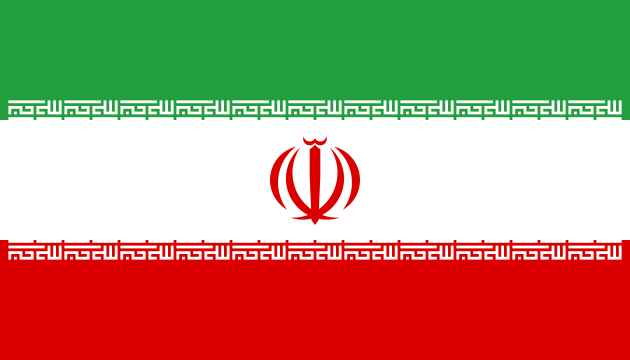
Iran
ایرانایران
Tournament outlook
2026-05-27Seven failed attempts at the knockout rounds, and one more chance
- ▸Iran has never advanced past the World Cup group stage in six previous appearances (1978, 1998, 2006, 2014, 2018, 2022)
- ▸Sardar Azmoun's omission — reported as a disciplinary call over loyalty to the state — robs the team of a key Plan B
- ▸FIFA's May 19, 2026 confirmation that pre-revolutionary 'Lion and Sun' flags will be banned at venues
- ▸Visa-issue saga from May 16, 2026 at FIFA Istanbul meeting — players must travel to Ankara for US and Canadian embassy interviews
- ▸Pre-tournament camp relocated from the United States to Mexico
- ▸Mehdi Taremi's third World Cup — and likely last — as captain
- ▸Amir Ghalenoei's bet on a Persian Gulf Pro League-heavy squad over diaspora-based selection
Iran’s seventh World Cup carries the same statistical weight as their previous six: never out of the group stage. Carlos Queiroz nearly broke the streak in 2018 against Spain and Portugal; this time, the burden falls on a coach with deep domestic credibility but limited international resume, leading a squad that is — by deliberate design — built around the Persian Gulf Pro League rather than the European-based diaspora.
The structural problem is the draw. Belgium are clear favourites in Group G, Egypt has the individual quality through Salah and Marmoush, and New Zealand are the only opponent Iran can plan to win against. Realistically, Team Melli’s path requires: (a) beating New Zealand on June 15 in Los Angeles, (b) holding Belgium to a draw or losing by one in the June 21 match at the same venue, and (c) beating or drawing Egypt in the June 26 decider in Seattle. That’s the route to second place and Round of 16 history. It is possible but optimistic.
The most likely outcome is third place in Group G — a respectable showing without breakthrough. Ghalenoei’s defensive structure has been excellent in Asian competition (semi-final at the 2023 Asian Cup is real evidence), but the step up to a Belgium or Egypt level of opponent will test whether his 4-1-3-2 holds together for a full 90 minutes against a quality opponent. The Azmoun omission removes flexibility in attack; the off-field turbulence around visas, camp relocations and the FIFA flag ruling adds a layer of distraction no team welcomes. Captain Mehdi Taremi remains the variable that matters most. If he gets even half the chances his Olympiacos form usually produces, Iran scores. If the team can’t create for him, the tournament ends — again — at the group stage.
About the team
depth: deepTeam Melli's defiant domestic project
Defensive solidity, compact lines, counter-attacking efficiency, set-piece threat · 4-1-3-2 (variants of 5-3-2 against stronger opposition)
Topped their AFC qualifying group; reached semi-final of the 2023 AFC Asian Cup under Ghalenoei; recent friendlies against Nigeria and Costa Rica per FourFourTwo reporting.
- Mehdi Taremi — clinical, big-game forward at Olympiacos
- Settled, drilled defensive shape
- Domestic-based core trains together year-round
- Goalkeeper Beiranvand in his third World Cup cycle
- Sardar Azmoun omission removes a Plan B in attack
- Limited creativity in central midfield against deep blocks
- Only eight foreign-based players — limited elite-competition exposure for many
- Off-field disruption: visa issues, camp relocation to Mexico, FIFA flag controversy
Iran arrive at their seventh World Cup with the same record they’ve carried into every previous one: never out of the group stage. Manager Amir Ghalenoei, in his second stint with Team Melli after a brief 2007-2008 spell, has built a squad explicitly designed to break that jinx — and made the controversial decision to ground it overwhelmingly in the domestic Persian Gulf Pro League. Only eight of his 30 preliminary players are foreign-based, a clear philosophical shift away from the European-heavy squads of the Carlos Queiroz years.
The tactical setup is unmistakably Ghalenoei: a 4-1-3-2 base with disciplined compact lines, willingness to drop into a 5-3-2 against stronger opposition, and a relentless focus on transition. Mehdi Taremi, the captain and the clearest world-class talent in the squad, plays as the focal point, supported by Alireza Jahanbakhsh’s experience and Saman Ghoddos’s link play. In behind them, Rouzbeh Cheshmi anchors the midfield — the same Cheshmi who scored against Wales at Qatar 2022 — and Ehsan Hajsafi continues to log caps from left-back at 36. The absence of Sardar Azmoun, reportedly omitted after a perceived act of disloyalty to the government, is the squad’s biggest story and removes Iran’s most credible Plan B forward.
Off the pitch, Iran’s preparation has been turbulent. The team had its US-based pre-tournament camp denied and will instead be hosted by Mexico, traveling to Ankara for visa interviews at the Canadian and American embassies after the original Dubai-consulate route fell through. On 19 May 2026, FIFA confirmed it would re-enforce the ban on pre-revolutionary “Lion and Sun” Iranian flags inside venues, citing political-symbol rules — a decision that delighted the Tehran government and infuriated much of the Iranian diaspora. The political backdrop will follow Team Melli through the entire tournament.
Group G offers a familiar pattern for Iran: one elite opponent (Belgium), one fellow continental power (Egypt), and one Oceania side they will be heavily favoured against (New Zealand). Realistically, Iran’s tournament hinges on the New Zealand opener at the Los Angeles Stadium on June 15 and the Egypt decider on June 26 in Seattle. Beat New Zealand and draw or beat Egypt and Iran could finally — for the first time in their history — see the knockout rounds. Lose to either and the storyline becomes painfully familiar.
What’s different this time is the squad’s identity. Ghalenoei has staked his reputation on the belief that Iranian-league cohesion and tactical discipline can outperform a more cosmopolitan squad. It’s a bet that the team’s recent semi-final run at the 2023 Asian Cup partially validated. North America will deliver the verdict.
2026 kits
All 48 →Fan-drawn representations via Wikipedia's kit templates — not official renders.
The Manager
Full profile →Amir Ghalenoei
Iranian · since 2023-03-25
"Compact 4-1-3-2 with a single defensive midfield pivot, two strikers playing off each other, and a structural emphasis on defensive shape and counter-attacking discipline."
Amir Ghalenoei, born 22 November 1963 in Tehran, is the most successful coach in Iranian club football history and, since March 2023, is in his second spell in charge of the national team — a return that came after a five-year cycle dominated by foreign managers (Carlos Queiroz, Dragan Skocic, Queiroz again). Five Pro League titles, two Hazfi Cup wins, and a five-club Iranian-football résumé make him a homegrown counter-example to the federation’s traditional preference for European coaches.
His first national-team stint, between August 2006 and July 2007, ended after a quarter-final exit at the 2007 AFC Asian Cup. He was, at the time, considered tactically conservative and personally abrasive — and he spent the next 15 years building his case at club level, with title-winning stints at Esteghlal and Sepahan firmly establishing him as Iran’s most decorated domestic manager. When Skocic was sacked after a poor 2023 Asian Cup preparation, Ghalenoei was the politically and footballingly obvious replacement.
His tactical signature is the 4-1-3-2: a single holding midfielder (often Cheshmi or Ezatolahi), a flat band of three ahead of him, and two strikers — typically Taremi with a partner playing slightly off him. The shape is built for defensive solidity first, with both wide midfielders required to tuck in to form a compact mid-block. Against stronger opposition, Ghalenoei drops into a clear 5-3-2 with wing-backs, as he did effectively at the 2023 AFC Asian Cup en route to the semi-finals. Counter-attacks are channeled through Taremi and through set pieces, where Iran’s height across the back four becomes a genuine threat.
The most distinctive feature of his 2026 squad is his explicit choice to lean on the Persian Gulf Pro League. Only eight of the 30 preliminary players are foreign-based. Ghalenoei argues that domestic cohesion outweighs the marginal individual quality of fringe European-based players — and that a national team training together year-round through Persepolis, Tractor, Sepahan and Esteghlal is more tactically coachable than a scattered diaspora squad. The omission of Sardar Azmoun, reported as a disciplinary decision over perceived disloyalty to the state, illustrates the harder edge of that philosophy: Ghalenoei demands buy-in to the project, and players who don’t fit — for any reason — are removed.
He faces a defining tournament. Iran has never escaped the World Cup group stage in seven attempts. The pressure to break that streak, combined with the political turbulence around the Iranian flag ban and visa issues, will test whether his style — built for the Asian context — translates to a more open global stage.
Squad
26 players · announced 2026-06-02The chip on each player is their WC26 rating, tinted by tier:
- 85+ elite
- 75–84 strong
- 65–74 solid
- <65 squad
Gold outline = projected starting XI (best XI by rating, club minutes, caps & FC26).
Goalkeepers
Defenders
- 84 Ramin Rezaeian N/A Foolad (IRN1) 60c 3g
- 81 Milad Mohammadi N/A Persepolis (IRN1) 60c 0g
- 80 Ehsan Hajsafi N/A Sepahan (IRN1) 135c 8g
- 56 Hossein Kanaani N/A Persepolis (IRN1) 30c 1g
- 54 Shoja Khalilzadeh N/A Tractor (IRN1) 35c 2g
- 52 Saleh Hardani N/A Esteghlal (IRN1) 15c 0g
- 50 Ali Nemati N/A Foolad (IRN1) 8c 0g
- 47 Danial Eiri N/A Malavan (IRN1) 6c 0g
Midfielders
- 86 Alireza Jahanbakhsh N/A Dender (BEL1) 80c 14g
- 77 Saeid Ezatolahi N/A Shabab Al-Ahli (UAE1) 60c 1g
- 76 Mohammad Mohebi N/A Rostov (RUS1) 20c 2g
- 66 Saman Ghoddos N/A Al Kalba (UAE1) 45c 5g
- 57 Mehdi Ghaedi N/A Al-Nasr (UAE1) 30c 4g
- 54 Mehdi Torabi N/A Tractor (IRN1) 50c 7g
- 51 Rouzbeh Cheshmi N/A Esteghlal (IRN1) 30c 4g
- 47 Mohammad Ghorbani N/A Al-Wahda (UAE1) 6c 0g
- 46 Amir Mohammad Razzaghinia N/A Esteghlal (IRN1) 8c 1g
- 45 Aria Yousefi N/A Sepahan (IRN1) 4c 0g