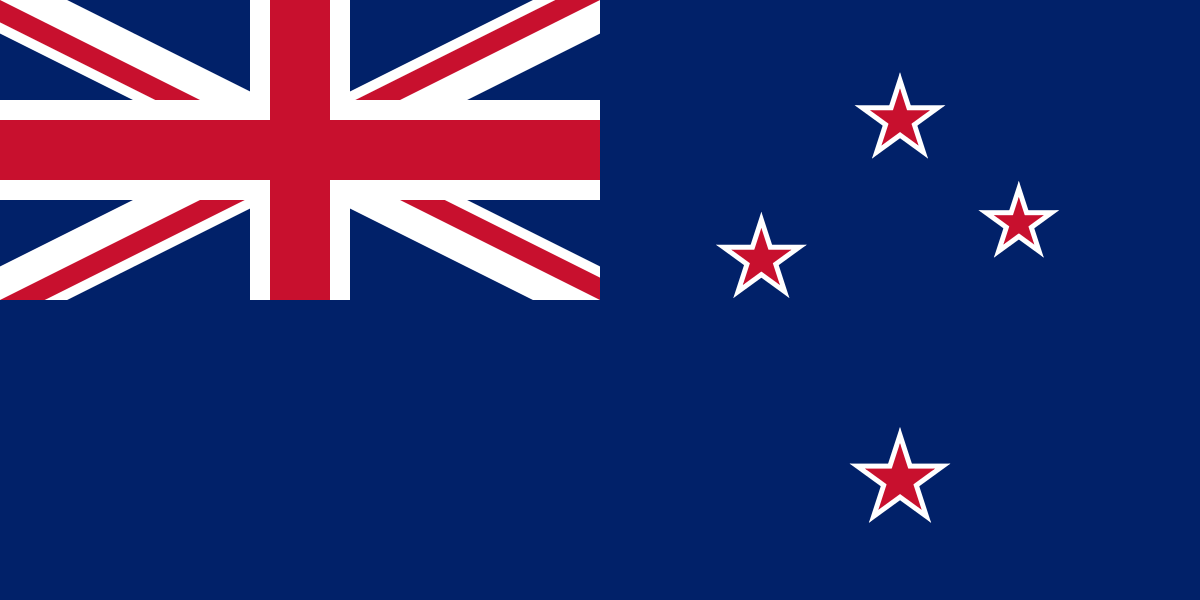
New Zealand
AotearoaAotearoa
Tournament outlook
2026-05-27Three matches, one shot at a moment of immortality
- ▸First World Cup appearance since 2010 — a 16-year wait ends
- ▸Chris Wood and Tommy Smith become the first New Zealanders to play at two World Cups
- ▸Direct OFC qualification (no playoff) for the first time, reflecting the new 48-team format
- ▸Darren Bazeley on track to become first coach to lead a country at every men's FIFA World Cup level (U-17, U-20, senior)
- ▸Auckland FC's A-League launch makes this a moment for New Zealand domestic football too
- ▸FIFA ranking of 86 — 78 spots below Belgium, the largest gap in any 2026 group
The honest realistic ceiling for New Zealand at the 2026 World Cup is one famous result — a draw against Iran, or a Chris Wood goal that triggers a viral celebration. The All Whites are, by every measurable indicator, the weakest team in Group G. FIFA’s pre-tournament ranking has them at 86, with Belgium at 8, Iran at 21 and Egypt at 32. The talent gap is real, the squad-depth gap is real, and the high-end ceiling has to acknowledge that.
What’s worth focusing on instead is the symbolic weight. New Zealand last played at a World Cup in 2010, where they remarkably went home undefeated after three draws against Slovakia, Italy and Paraguay. Sixteen years later, Chris Wood and Tommy Smith — Smith now at sixth-tier National League side Braintree Town — return as the only members of that side still active for the national team. A Bazeley-coached All Whites side will not embarrass themselves. They are too organized, too physically committed, and have too much set-piece structure to be a Saudi-Arabia-vs-Germany-style cautionary tale. But they will also be very unlikely to take points.
The most likely scenario across the three matches: a tight, low-scoring opener against Iran where Bazeley’s defensive 4-4-2 frustrates Ghalenoei’s defensive 4-1-3-2 in a 1-0 or 0-0; a heavy defeat to Egypt; and a respectable but unsuccessful effort against Belgium in the final group game, perhaps with a consolation goal. Three losses, single-digit total goals against, and a tournament every New Zealand football fan will treasure regardless of result. The All Whites are not here to win the group. They are here to be present, to be visible, and to remind global audiences that football matters in the only nation that produced both Wynton Rufer and the Phoenix-to-Forest pipeline that gave the Premier League Chris Wood.
About the team
depth: standardAll Whites back on the biggest stage, captained by Chris Wood
Disciplined defensive shape, route-one threat through Wood, work-rate-first identity · 4-4-2 (compact, mid-to-low block)
Cruised through OFC qualifying, finishing the campaign undefeated and unbeaten in the qualifying playoffs to seal direct entry to the 2026 World Cup.
- Chris Wood — proven Premier League striker
- Set-piece threat with Tommy Smith, Boxall and Wood in the box
- Tactical discipline drilled across multiple Oceania cycles
- Liberato Cacace as an attacking outlet from left-back
- Significant gap in technical quality to Group G opposition
- Goal creation outside Wood is thin
- Limited squad depth, with several lower-division English-club players
- FIFA ranking of 86 — by far the lowest in the group
The All Whites arrive at their third World Cup — and first since South Africa 2010 — buoyed by direct OFC qualification (a luxury Oceania didn’t have for previous cycles) and led by Chris Wood, the Nottingham Forest striker who is now indisputably the greatest goalscorer in New Zealand football history. Wood, 34, will become only the second New Zealander to play at two World Cups, alongside 36-year-old Tommy Smith, the National League defender at Braintree Town who somehow finds himself in Group G with Belgium and Egypt.
Darren Bazeley’s squad is a textbook study in pragmatism. The starting eleven is built around a disciplined 4-4-2 with two banks of four, Wood as the primary outlet, and Cacace as the most consistent attacking creator from left-back. Marko Stamenić, on loan at Swansea from Olympiacos, gives the midfield a player who can carry the ball through pressure. Tyler Bindon, Wood’s teammate at Nottingham Forest, has emerged as the modern center-back of the group, while Boxall and Smith provide the physical core in the box for both penalty areas. Three goalkeepers cover the position: Crocombe, the rising Paulsen, and Eredivisie-based Woud.
The squad is, by Group G standards, technically the weakest. New Zealand’s FIFA ranking of 86 places them 78 spots below Belgium, 54 below Iran, and 65 below Egypt. The honest projection is two defeats and one tight match where New Zealand frustrate an opponent into a stalemate. The most plausible target is Iran in the June 15 opener at Los Angeles Stadium, where the All Whites’ physical set-piece threat against Iran’s defensive 4-1-3-2 sets up an awkward, low-scoring 90 minutes.
What the All Whites bring that few teams in the tournament can match is institutional resilience. Bazeley has been embedded in New Zealand football since the mid-2000s — he played for the short-lived NZ Knights, coached the U-17s and U-20s, and worked across Oceania for over a decade before taking the senior job permanently in 2023. The set-piece routines, the defensive shape, the work without the ball — all of it is the product of long-term planning, not improvisation. Don’t expect goals; do expect a team that won’t be embarrassed.
For New Zealand football, the symbolic weight of this tournament is significant. Auckland FC’s A-League launch has reinvigorated the domestic scene; six of the 26-man squad play in New Zealand, four for Auckland FC alone. A respectable World Cup — even one without points — can fuel a generation. A famous result against Iran or a single goal against Belgium would be the kind of moment that lives in highlight reels forever.
2026 kits
All 48 →Fan-drawn representations via Wikipedia's kit templates — not official renders.
The Manager
Full profile →Darren Bazeley
English · since 2023-09-01
"Compact 4-4-2 with a low-to-mid block, organized defensive shape, route-one attack through Chris Wood, and set-piece structure as a primary scoring source."
Darren Shaun Bazeley, born 5 October 1972 in Northampton, England, has been embedded in New Zealand football since 2005, when he signed with the short-lived New Zealand Knights for the inaugural A-League season. He played all 21 matches of that doomed first season — the Knights folded in 2007 — and has remained in the country ever since, working his way through every level of New Zealand Football’s coaching pyramid. He took over the All Whites on a permanent basis in September 2023 after a successful interim spell. He is, by some distance, the longest-tenured football coach inside New Zealand football right now.
As a player, Bazeley made nearly 300 appearances for Watford between 1989 and 1999, including in their Premier League season under Graham Taylor, before spells at Wolves and Walsall. He was a hard-running right-back or wide midfielder — a profile that translates directly into the tactical preferences he now demands of his All Whites. His sides are organized, hard to break down, and demand physical investment from every player on the pitch.
His coaching CV is unusual. After Knights playing days he transitioned into youth coaching with Waitakere United and then New Zealand Football’s national pathway, taking the U-17s in 2012 and the U-20s in 2013. He coached New Zealand to two FIFA U-20 World Cups, including the home tournament in 2015 where the side reached the round of 16. He then spent a five-year stint as an assistant in North America with Colorado Rapids under Anthony Hudson, before returning Down Under in 2020 to assist Carl Robinson at the Newcastle Jets in the A-League. When Hudson — who briefly held the All Whites job — moved on, Bazeley returned to the New Zealand setup and took the senior role.
Tactically, Bazeley plays a flat 4-4-2 with extreme discipline: two banks of four, Wood pressing the opposition’s first defender, the second striker (often Garbett or McCowatt) playing slightly behind. Defensively, the team sits in a low-to-mid block against superior opponents and only commits players forward in clearly defined transition moments. Set pieces are a structured priority — Tommy Smith, Boxall and Wood all attack the front post; Cacace and Stamenić whip in from open play. Per FIFA, Bazeley will become the first coach to have led national teams at all three FIFA men’s competition tiers (U-17, U-20, senior World Cup) if the All Whites take the pitch in June. Whatever happens in Group G, the symbolic weight of his journey is already secured.

Squad
26 players · announced 2026-05-14The chip on each player is their WC26 rating, tinted by tier:
- 85+ elite
- 75–84 strong
- 65–74 solid
- <65 squad
Gold outline = projected starting XI (best XI by rating, club minutes, caps & FC26).
Goalkeepers
Defenders
- 74 Tyler Bindon FC26 Nottingham Forest (ENG1) 23c 3g
- 74 Liberato Cacace FC26 Wrexham (ENG2) 35c 1g
- 70 Michael Boxall (vc) FC26 Minnesota United (USA1) 61c 1g
- 62 Tim Payne N/A Wellington Phoenix (AUS1) 50c 3g
- 67 Francis de Vries FC26 Auckland FC (AUS1) 18c 1g
- 66 Finn Surman FC26 Portland Timbers (USA1) 17c 2g
- 65 Nando Pijnaker FC26 Auckland FC (AUS1) 23c 0g
- 58 Callan Elliot FC26 Auckland FC (AUS1) 9c 0g
- 44 Tommy Smith N/A Braintree Town (ENG5) 56c 2g
Midfielders
- 75 Joe Bell FC26 Viking FK (NOR1) 31c 1g
- 74 Marko Stamenić FC26 Swansea City (ENG2) 37c 3g
- 46 Matt Garbett FC26 Peterborough United (ENG3) 36c 5g
- 69 Ryan Thomas FC26 PEC Zwolle (NED1) 25c 3g
- 66 Alex Rufer FC26 Wellington Phoenix (AUS1) 24c 0g
- 54 Lachlan Bayliss FC26 Newcastle Jets (AUS1) 2c 0g
- 51 Sarpreet Singh N/A Wellington Phoenix (AUS1) 26c 3g
- 44 Ben Old FC26 Saint-Étienne (FRA2) 22c 2g