
Scotland
Scotland / AlbaScotland / Alba
Tournament outlook
2026-05-27First World Cup in 28 years — and a chance to finally escape the group
- ▸Scott McTominay's overhead kick vs. Denmark on 18 November 2025 — the qualifying-defining moment, now a Glasgow mural
- ▸Ewan McGregor voiced the squad-reveal video on 19 May 2026 ('Choose Scotland', Trainspotting cadence)
- ▸First World Cup since France 1998 — and Brazil and Morocco are in the group again
- ▸Andy Robertson captains the squad with 92 caps; Craig Gordon in goal at 43, his fourth tournament
- ▸Findlay Curtis (18, Kilmarnock) is the squad surprise
Scotland have not appeared at a World Cup since France 1998. That is the dominant fact about this group, and the reason the tournament feels different in Glasgow and Edinburgh than at any time since the late 1990s. The wait ended on 18 November 2025 at Hampden Park, when Scott McTominay’s overhead kick — already painted as a mural by the time the squad video was released in May 2026 — and a Ché Adams finish saw off Denmark 4-2 in a UEFA Group C decider and confirmed a World Cup berth via the playoff route. The mural, on Glasgow’s Finnieston Street, became the visual centerpiece of the squad-reveal video released on 19 May 2026, in which Ewan McGregor’s Trainspotting-cadenced “Choose Scotland” monologue went viral inside hours.
The squad itself is the product of Steve Clarke’s six-year reset. Andy Robertson (Liverpool, 92 caps) is captain. McTominay, fresh off a Serie A title with Napoli, and his club teammate Billy Gilmour are the midfield core. John McGinn (Aston Villa) carries the late-arrival goal threat. Aaron Hickey (Brentford) and Ben Doak (Bournemouth) provide the Premier League pace. Craig Gordon (Hearts), at 43, is making his fourth tournament call-up, a record at the international level. The surprise inclusion is 18-year-old Findlay Curtis of Kilmarnock. Of the 26-man squad, four play in Serie A, several in the Premier League, and the rest are spread across the Scottish Premiership, the EFL Championship, the Eredivisie, and beyond.
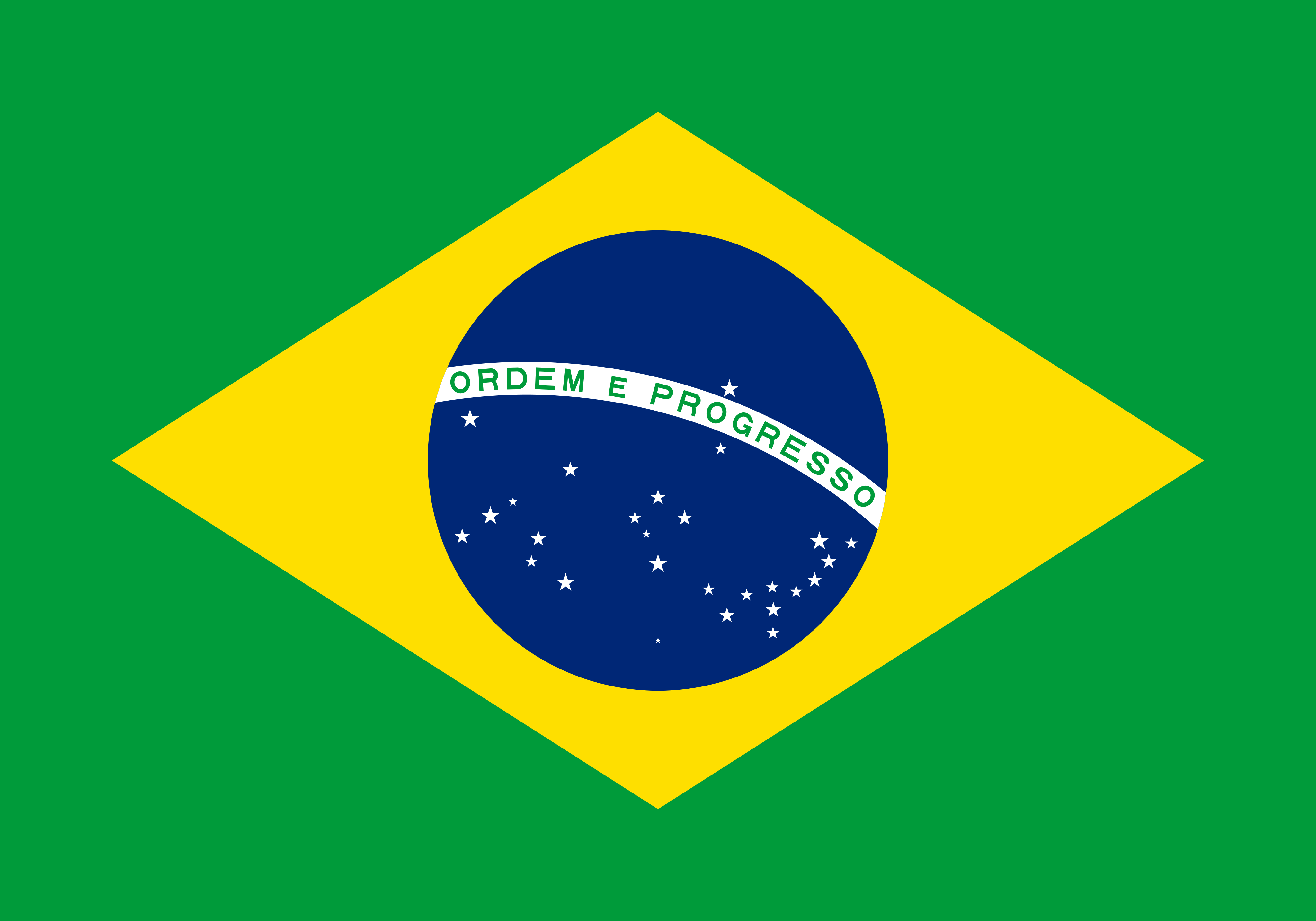
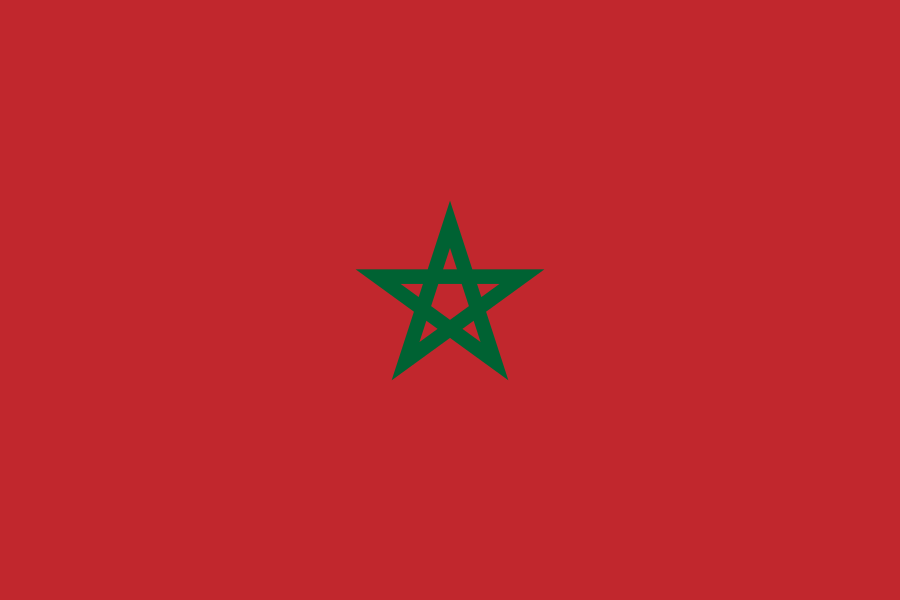
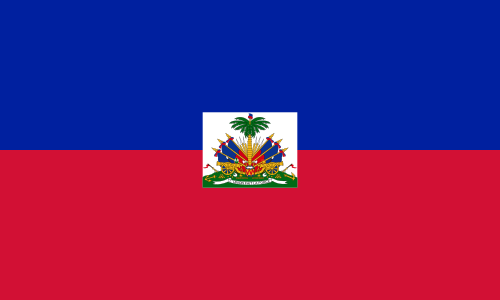
Group C is, historically, the same group Scotland were drawn into for France 1998 — Brazil, Morocco, and the Scots, with Norway as the fourth back then. Scotland lost the opener to Brazil 2-1 at the Stade de France, drew with Norway, and lost 0-3 to Morocco in Saint-Étienne. The repeat draw 28 years on is one of the strangest coincidences of the tournament. The fixture order is different — Haiti first in Boston, Morocco second in Boston, Brazil last in Miami — which gives Clarke a path that is the inverse of 1998’s. If Scotland take care of Haiti on 13 June (and the data says they will), a result against Morocco on 19 June puts them within touching distance of a knockout-stage appearance for the first time in the country’s history. The Brazil game on 24 June at Hard Rock Stadium, by that point, may matter less than McGregor’s voiceover suggests.
About the team
depth: deepFirst World Cup in 28 years — McTominay's overhead kick, Ewan McGregor's voiceover, and a date with destiny
Defensive solidity in a back five, wing-back overloads with Robertson and Hickey, transitional threat through McTominay's late runs, McGinn's box arrivals, and Doak's directness · 3-4-2-1 / 5-4-1 (out of possession)
Qualified via UEFA Group C with a 4-2 home win over Denmark on 18 November 2025 — McTominay's overhead kick the iconic moment, Adams also scoring. Lost 3-2 to Greece earlier in the campaign. First World Cup qualification since France 1998.
- Genuine spine of Premier League / Serie A regulars — Robertson, McTominay, Gilmour, McGinn
- Big-game tournament experience banked at Euro 2020 and Euro 2024
- Clarke's tactical discipline and unprecedented continuity (since May 2019)
- Set-piece scoring threat — McTominay and Adams both score from them
- Goalscoring depth — Lyndon Dykes and Ross Stewart returning from injury layoffs
- No World Cup wins since 1990 (one draw in 1998)
- Centre-back depth thin behind Hanley and Souttar
- Group C historical curse: drawn with Brazil and Morocco again, 28 years on
Scotland’s 28-year wait ended on 18 November 2025 at Hampden Park, when Scott McTominay’s overhead kick — already painted as a mural by the time the squad video was released — and a Ché Adams finish saw off Denmark 4-2 to clinch UEFA Group C and a first World Cup since 1998. The win triggered scenes that older Scots last witnessed under Craig Brown. Steve Clarke, in role since May 2019, became the first coach to qualify Scotland for three major tournaments (Euro 2020, Euro 2024, World Cup 2026) and is now the longest-serving manager in the country’s history by games managed.
Tactically, Clarke’s Scotland is a back-five team. The base shape is 3-4-2-1, with Robertson and Hickey/Patterson pushing high as wing-backs, Hanley/Souttar/Tierney rotating in the back three, and Gilmour and McGinn carrying possession in central midfield. McTominay plays as a roaming No. 8/10 hybrid — the man who has rescued the campaign multiple times with late goals. Out of possession the shape collapses to 5-4-1, with Doak or Adams left isolated up top to threaten on the counter. It is unfashionable football, but it has produced three consecutive tournament qualifications from a country whose previous decade was a string of near-misses.
The squad blends Premier League and Serie A regulars with deeply local Scottish Premiership players. Robertson (Liverpool, 92 caps) is captain. McTominay (Napoli) and Gilmour (Napoli) reunite as Serie A winners. McGinn (Aston Villa), Christie (Bournemouth), Hickey (Brentford), Doak (Bournemouth), and Adams (Torino) carry the top-flight load. Craig Gordon, the 43-year-old Hearts goalkeeper, is making his fourth tournament appearance — a record that, even at the international level, is striking. Findlay Curtis, an 18-year-old Kilmarnock midfielder, is the squad’s surprise selection.
Scotland announced the squad on 19 May 2026 in a video voiced by Ewan McGregor, whose Trainspotting-rhythmed monologue (“Choose Scotland”) became the highest-engagement piece of Scottish football media of the year. McGregor, who supported the team during the 1998 World Cup, recorded the piece in front of the mural depicting McTominay’s overhead-kick.
History: Scotland have appeared at eight previous World Cups (1954, 1958, 1974, 1978, 1982, 1986, 1990, 1998) and have never advanced beyond the group stage — a record that hangs heavier than any other in the country’s footballing consciousness. The 1998 campaign, in which they opened against Brazil at the Stade de France, drew with Norway, and lost 0-3 to Morocco in Saint-Étienne, is the direct historical antecedent of this 2026 group draw.
Ceiling: round of 16, the first knockout-stage Scotland team in history, achievable if they take care of Haiti and steal a result against Morocco. Floor: three losses, a continuation of 90 years of group-stage heartbreak. Most likely: a win over Haiti, a tight loss to Morocco, and a heavy defeat to Brazil — finishing third on goal difference. But the gap between most-likely and ceiling, if McTominay produces one more moment, is genuinely small.
2026 kits
All 48 →Fan-drawn representations via Wikipedia's kit templates — not official renders.
The Manager
Full profile →Steve Clarke
Scottish · since 2019-05
"Pragmatic defensive structure first. Operates a 3-4-2-1 with a deep back five against superior opposition, drops to 5-4-1 out of possession, and looks to win the moments — set pieces, transitions, McTominay late runs. Builds long-term relationships with his squad and rotates only when forced."
Steve Clarke’s qualification of Scotland for the 2026 World Cup is the third tournament-qualifying achievement of a tenure that, when it began in May 2019, did not look obviously bound for any of them. Clarke was a respected Premier League assistant — Chelsea under Mourinho through the Champions League final years, West Ham, Liverpool — and a journeyman manager in his own right, with stints at West Brom, Reading, and Aston Villa’s assistantship, before a transformative two seasons at Kilmarnock (2017-2019) earned him both the Scottish Premiership Manager of the Year award in 2016-17 and the Scotland job.
He inherited a national team in long-term decline. Scotland had not qualified for a major tournament since France 1998, the run of failures spanning Wenger-era through to Brexit. Clarke’s first qualification — Euro 2020 — broke that 23-year drought. He followed it with Euro 2024 (group-stage exit, but still a qualification), and most recently with a 4-2 win over Denmark at Hampden Park on 18 November 2025 — Scott McTominay’s overhead kick the iconic moment, Ché Adams the second goal — that booked Scotland’s place in North America via UEFA Group C and a playoff-route resolution. By that point, Clarke had become both the longest-serving Scotland manager by games managed and the first head coach in the country’s history to qualify for three consecutive major tournaments.
Tactically, Clarke is conservative in a manner that has aged well. His Scotland sets up in a 3-4-2-1 with Robertson and Hickey or Patterson at wing-back, a back three rotated from Hanley, Souttar, Tierney, McKenna, and Hendry, and Gilmour and McTominay (with McGinn drifting forward) in central midfield. The shape compresses into a 5-4-1 out of possession, ceding territory and relying on transitions, set pieces, and the goal threat of McTominay’s late runs. It is unfashionable football — Scotland conceded three to Greece in qualifying, scoring two, and lost — but it is internally coherent and it has produced results when the players have been able to execute it.
The squad announcement on 19 May 2026, with Ewan McGregor voicing the reveal video in a Trainspotting-cadenced “Choose Scotland” monologue in front of the mural of McTominay’s overhead kick, captured the cultural weight of what Clarke has built. There are 26 players: Robertson (92 caps) as captain, four Serie A players (McTominay, Gilmour, Adams, Ferguson), a 43-year-old Craig Gordon in goal on his fourth tournament call-up, and an 18-year-old Findlay Curtis from Kilmarnock as the surprise inclusion.
His stake at this World Cup is straightforward. Scotland have never advanced past a World Cup group stage. Group C — Brazil, Morocco, Haiti — is a draw that contains both nations who knocked them out in 1998. To get out of the group, Clarke needs Robertson and McTominay to play at their European-club level, the back five to hold against Brazil’s wide isolation, and one moment from a set piece or a transition to flip a game. If he produces it, his place as the most consequential Scotland manager of the modern era is sealed.
Squad
26 players · announced 2026-05-19The chip on each player is their WC26 rating, tinted by tier:
- 85+ elite
- 75–84 strong
- 65–74 solid
- <65 squad
Gold outline = projected starting XI (best XI by rating, club minutes, caps & FC26).
Goalkeepers
Defenders
- 96 Andy Robertson (c) FC26 Liverpool (ENG1) 92c 4g
- 75 John Souttar FC26 Rangers (SCO1) 22c 1g
- 69 Anthony Ralston FC26 Celtic (SCO1) 14c 1g
- 63 Grant Hanley FC26 Hibernian (SCO1) 56c 4g
- 90 Kieran Tierney FC26 Celtic (SCO1) 47c 1g
- 78 Nathan Patterson FC26 Everton (ENG1) 25c 1g
- 78 Scott McKenna FC26 Dinamo Zagreb (CRO1) 32c 2g
- 75 Jack Hendry FC26 Al-Ettifaq (KSA1) 30c 1g
- 66 Aaron Hickey FC26 Brentford (ENG1) 12c 0g
- 66 Dom Hyam FC26 Wrexham (ENG2) 3c 0g
Midfielders
- 96 Scott McTominay FC26 Napoli (ITA1) 65c 14g
- 95 John McGinn FC26 Aston Villa (ENG1) 75c 19g
- 93 Ryan Christie FC26 Bournemouth (ENG1) 56c 6g
- 82 Lewis Ferguson FC26 Bologna (ITA1) 18c 1g
- 77 Kenny McLean FC26 Norwich City (ENG2) 41c 4g
- 60 Ben Doak FC26 Bournemouth (ENG1) 14c 1g
- 55 Tyler Fletcher N/A Manchester United (ENG1) 1c 0g
- 55 Findlay Curtis FC26 Kilmarnock (SCO1) 2c 0g