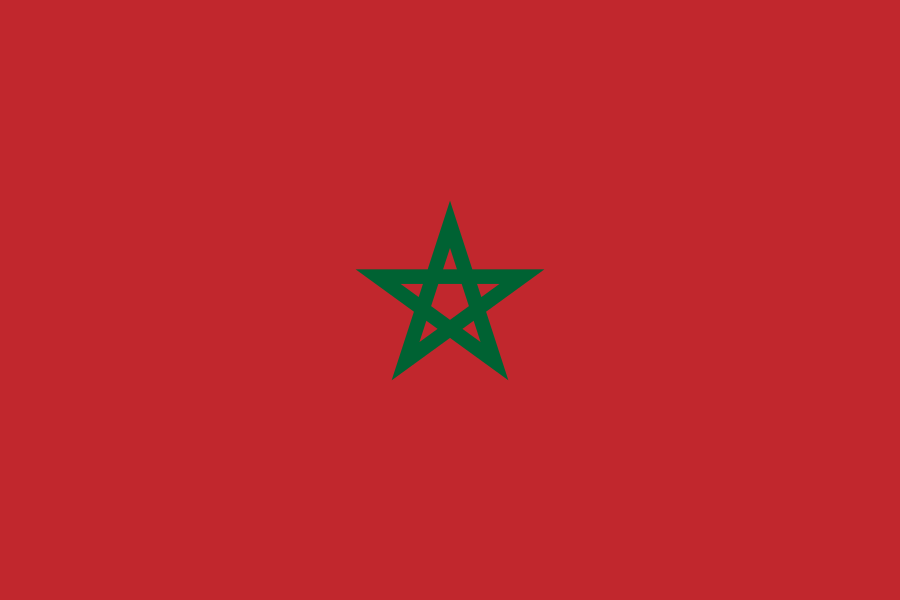
Morocco
المغربالمغرب
Tournament outlook
2026-05-27Defending the 2022 ceiling under a coach with three months on the job
- ▸Mohamed Ouahbi inherited the team three months ago after Regragui's post-AFCON-final resignation
- ▸Sixteen of 26 players are new faces compared to Qatar 2022
- ▸Hakimi remains the world's best right-back, and the captain in all but title
- ▸Brahim Díaz now leads the front line — En-Nesyri, Ziyech, and Boufal all omitted
- ▸Group C reunion of 1998: Brazil and Morocco were in Scotland's group then, too
Morocco arrive in Group C carrying the most complicated set of expectations of any team in the bottom half of the bracket. Four years ago in Qatar, they became the first African and Arab nation to reach a World Cup semifinal — beating Belgium, Spain, and Portugal — and the cultural and political weight of that run has not faded. They are now expected to advance. But the team that does the advancing is no longer the team that did it in 2022. Walid Regragui, the coach who built that run, resigned on 5 March 2026, three days after Morocco lost the AFCON final 1-0 to Senegal in Rabat. His replacement, Mohamed Ouahbi — a 49-year-old Belgian-Moroccan with no senior managerial experience but a freshly-won FIFA U-20 World Cup title with Morocco’s youth side — has had fourteen weeks to install his ideas before the tournament begins.
The retention from 2022 is the spine: Hakimi, Bounou, Aguerd, Amrabat, Mazraoui, and El Kaabi all return. The 4-3-3 mid-block shape that flummoxed Belgium and Portugal is unchanged. What has changed is the front line and the midfield’s creative wide players. Youssef En-Nesyri, the 2022 starting centre-forward, is out. So are Hakim Ziyech, Sofiane Boufal, and El Karouani. In their place are Brahim Díaz (Real Madrid), Chemsdine Talbi (Sunderland), Abde Ezzalzouli (Real Betis), Bilal El Khannouss (Stuttgart), and several U-20 graduates Ouahbi developed personally. It is a younger, less famous, and arguably more athletic group, but with no tournament reps in this combination.
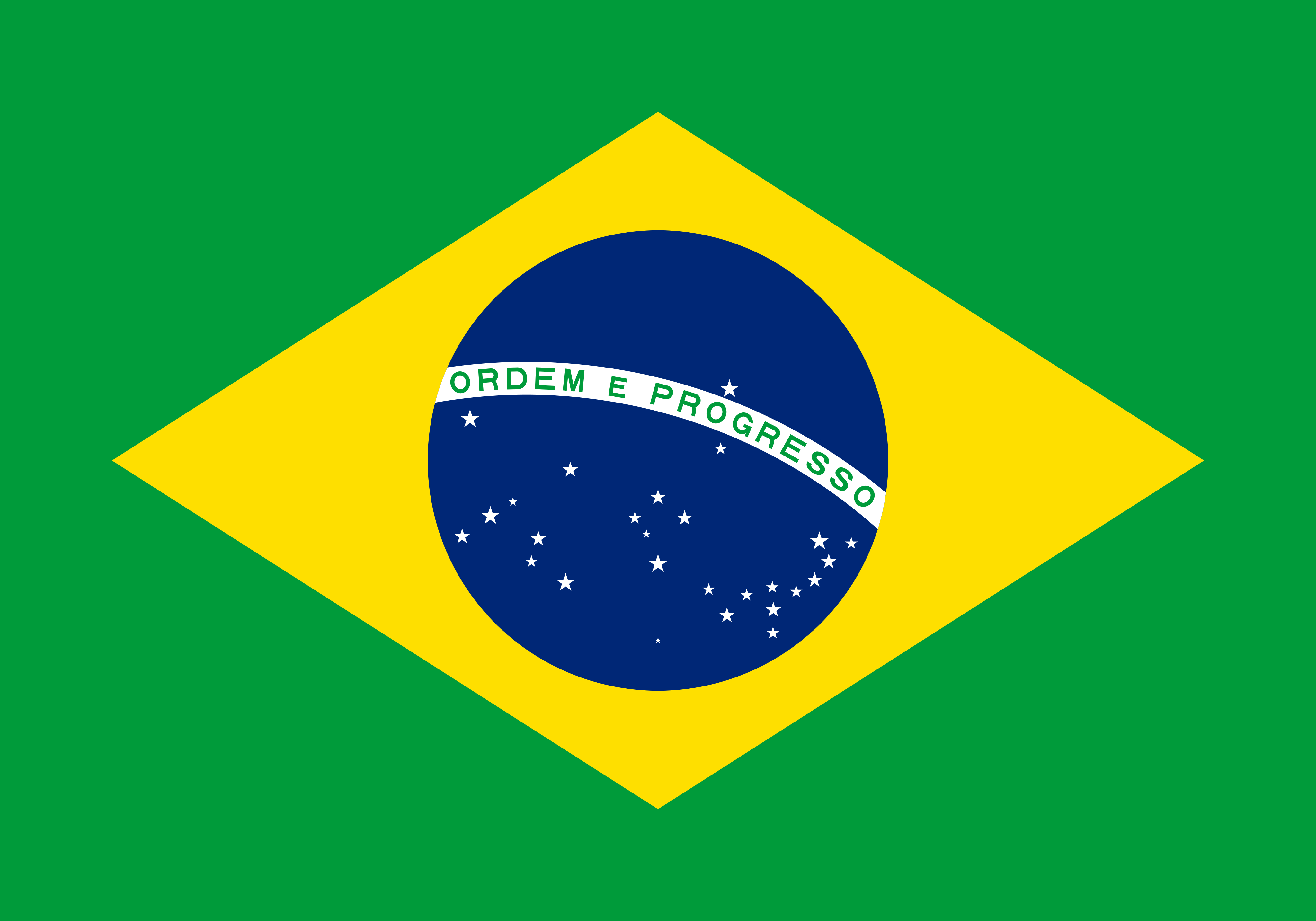
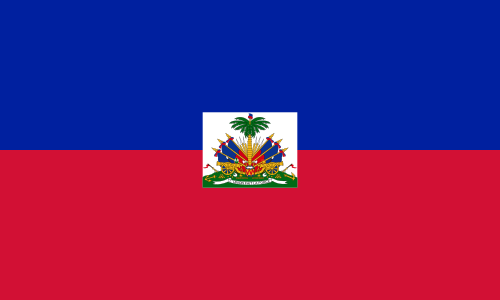
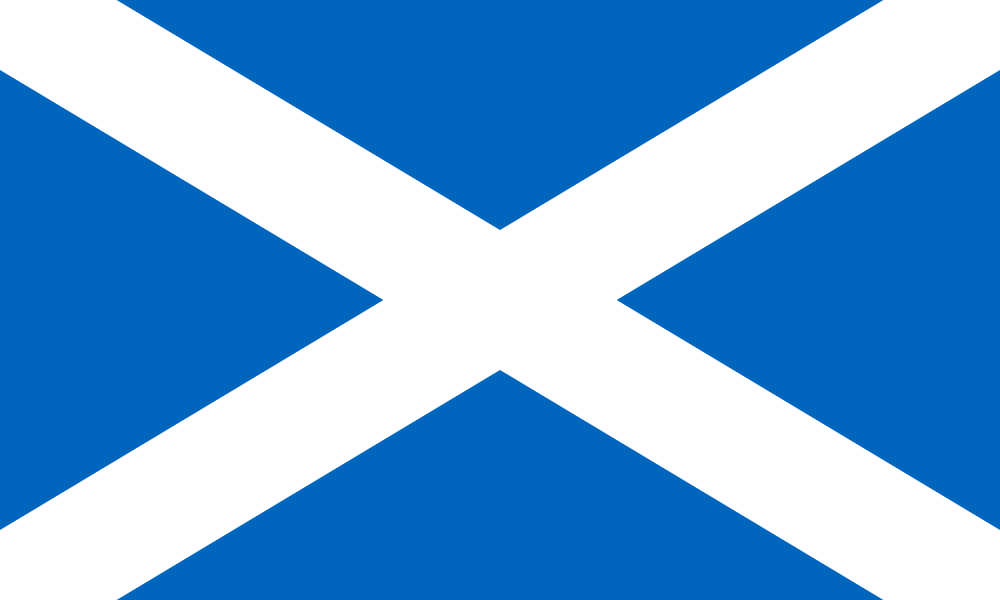
Group C feels historically heavy. Morocco, Brazil, and Scotland were drawn together in Group A at France 1998, and Morocco’s 3-0 win over Scotland in Saint-Étienne — Bassir scoring twice — remains one of the most one-sided games in either country’s World Cup history. The bracket-of-three repeats itself 28 years on, in different stadia (New York/New Jersey, Boston, Atlanta) but with the same competitive temperature. The opener against Brazil at MetLife on 13 June will set the tone: Morocco won the 2023 friendly between these sides 2-1 in Tangier under caretaker Hicham El Idrissi, and that result is the one piece of recent evidence the Atlas Lions can lean on. A draw or win in the opener, and the round of 16 becomes a formality. A loss, and the Scotland game on 19 June becomes a must-win — with all the pressure that brings on a coach who has been in post for less than four months.
About the team
depth: deepAtlas Lions return with a new coach and a 2022 ceiling to defend
Mid-block defensive solidity, vertical transitions through wide channels, structured set-piece attack — the Regragui blueprint retained, with younger legs · 4-3-3 / 4-1-4-1 (with Hakimi as auxiliary winger)
Strong qualifying campaign in CAF Group E. Reached 2025 AFCON final (lost 1-0 to Senegal in Rabat), which triggered Regragui's exit. Under Ouahbi (since March 2026), results in March/May friendlies have been quietly positive, with sixteen of the 26-man World Cup squad being newcomers compared to Qatar 2022.
- World-class right side: Hakimi attacking, Aguerd anchoring
- Goalkeeper depth — Bounou is one of the tournament's best between the sticks
- Tournament experience banked at 2022 World Cup and 2025 AFCON final
- Ouahbi's U-20 group (Chile 2025 winners) integrated into senior squad
- Coach in role only since March 2026 — minimal senior-team prep time
- Strikers — En-Nesyri, El Kaabi, Ziyech, Boufal all omitted or marginalised
- Amrabat carrying an injury load into the tournament
- Lost 2025 AFCON final 1-0 to Senegal on home soil — wounding result
Morocco arrive in Group C with the heaviest tactical legacy of any team in the bottom half of the bracket. Qatar 2022 — the run to the semifinals, the wins over Belgium, Spain, and Portugal, the 0-2 loss to France that felt closer than the scoreline — rewired what was possible for an African side. The Atlas Lions are no longer underdog novelty. They are a team expected to advance, with all the weight that brings.
The pre-tournament story, though, is turbulence. Walid Regragui — the man who built that 2022 run — resigned on 5 March 2026, three days after Morocco lost the AFCON final 1-0 to Senegal in Rabat. The federation moved fast, promoting Mohamed Ouahbi, a 49-year-old Belgian-Moroccan who had just won the U-20 World Cup in Chile in October 2025 after 17 years in Anderlecht’s academy. Ouahbi has no senior international experience and only weeks to install his ideas. To his credit, he has chosen continuity: Hakimi, Bounou, Amrabat, Aguerd, Mazraoui — the 2022 spine — all return. Sixteen of the 26-man squad are new since Qatar, but the system (4-3-3, defensive mid-block, vertical wide breaks, Hakimi roaming) is recognisably the Regragui blueprint.
The personnel-level news is in the omissions. Youssef En-Nesyri (Fenerbahçe), the 2022 starting centre-forward, is out. So are Hakim Ziyech and Sofiane Boufal, both heroes of Qatar. Ayoub El Kaabi — Olympiacos’ Conference League-winning striker — survived, but Brahim Díaz now headlines the attack alongside young wide players like Chemsdine Talbi (Sunderland) and Abde Ezzalzouli (Real Betis). It is a younger, more direct, less famous front line — and one with everything to prove.
Morocco have appeared at the World Cup seven times before 2026 — 1970, 1986, 1994, 1998, 2018, 2022 — with 1986 (round of 16, the first African team to advance from the group stage) and 2022 (fourth place) as the high-water marks. They drew Brazil and Scotland 28 years ago in France 1998: a 2-2 with Norway, a 0-3 loss to Brazil, and that 3-0 demolition of Scotland in Saint-Étienne that knocked both teams out. Group C is, in a real sense, a rematch from a generation ago.
Ceiling: a deep run, possibly quarterfinals or further, if Ouahbi can keep the 2022 spine playing the football it knows. Floor: group-stage exit if a striker doesn’t emerge and the new coach cannot replace Regragui’s man-management. Most likely: round of 16, with Brazil avoided in the bracket and a winnable draw on the other side.
2026 kits
All 48 →Fan-drawn representations via Wikipedia's kit templates — not official renders.
The Manager
Full profile →Mohamed Ouahbi
Belgian-Moroccan · since 2026-03-05
"Continuity over revolution. Has retained the 2022 Regragui blueprint — 4-3-3 mid-block, vertical wide transitions, Hakimi as inverted right-back — while accelerating the youth pipeline he had been managing himself. Anderlecht-trained, prizes structure and player development."
Mohamed Ouahbi’s path to the Morocco senior job is unlike that of almost any coach at the tournament. Born 7 September 1976 in the Cité des Ânes district of Schaerbeek, Brussels — to a family from Nador in northern Morocco — he started coaching at 21, taking youth teams at Maccabi Brussels in 1997. He then spent seventeen years inside the RSC Anderlecht academy, working across age groups and contributing to the development of players who would later reach top European leagues. It is a CV deliberately built away from the spotlight, and one that did not appear destined for a senior national role.
The pivot came in March 2022, when Royal Moroccan Football Federation president Fouzi Lekjaa appointed Ouahbi as head coach of Morocco’s U-20 national team. The bet paid off historically: Morocco U-20 won the 2025 FIFA U-20 World Cup in Chile in October of that year — the country’s first global title at any level, and the spark that put Ouahbi’s name on the federation’s emergency-replacement list when senior-team turbulence followed.
That turbulence arrived faster than expected. On 5 March 2026, three days after Morocco lost the AFCON final 1-0 to Senegal in Rabat on home soil, Walid Regragui — the architect of the 2022 World Cup semifinal run — resigned. The federation, with the World Cup itself only fourteen weeks away, turned to Ouahbi. He had never managed a senior side, let alone a national team headed for a World Cup. But Lekjaa’s logic was that the U-20 generation Ouahbi had just won the world title with was already being fed into the senior squad, and that continuity of voice mattered more than senior-team CV at this stage. Sixteen of the 26-man World Cup squad announced on 26 May are new faces compared to Qatar 2022.
His approach has been pragmatic. Hakimi, Bounou, Aguerd, Amrabat, Mazraoui, and El Kaabi — the spine of the 2022 squad — were all retained. The 4-3-3 shape, the mid-block defensive principles, and the Hakimi-narrows-against-elite-wingers wrinkle that Regragui used against Mbappé in the semifinal have all been preserved. What changes is the front line: En-Nesyri, Ziyech, and Boufal — all three 2022 heroes — are out, replaced by Brahim Díaz, Chemsdine Talbi (Sunderland), Abde Ezzalzouli (Real Betis), and others from Ouahbi’s U-20 pipeline. The stakes are high — Morocco are no longer a surprise, and the 2022 ceiling is now an expectation — but the federation’s bet is that the youngest coach at the tournament, working with the players he developed, can compress months of senior-team preparation into a winning fourteen weeks.
Squad
26 players · announced 2026-05-26The chip on each player is their WC26 rating, tinted by tier:
- 85+ elite
- 75–84 strong
- 65–74 solid
- <65 squad
Gold outline = projected starting XI (best XI by rating, club minutes, caps & FC26).
Goalkeepers
Defenders
- 96 Achraf Hakimi (c) FC26 Paris Saint-Germain (FRA1) 80c 11g
- 92 Noussair Mazraoui FC26 Manchester United (ENG1) 35c 1g
- 88 Nayef Aguerd FC26 Olympique de Marseille (on loan from West Ham) (FRA1) 42c 2g
- 78 Issa Diop FC26 Fulham (ENG1) 6c 0g
- 72 Zakaria El Ouahdi FC26 Genk (BEL1) 7c 0g
- 57 Chadi Riad FC26 Crystal Palace (ENG1) 9c 0g
- 50 Anass Salah-Eddine N/A Twente (NED1) 5c 0g
- 48 Redouane Halhal N/A Mechelen (BEL1) 3c 0g
- 46 Youssef Belammari N/A Al Ahly (EGY1) 4c 0g
Midfielders
- 93 Ismael Saibari FC26 PSV Eindhoven (NED1) 16c 4g
- 80 Sofyan Amrabat FC26 Real Betis (on loan from Fenerbahçe) (ESP1) 60c 1g
- 78 Neil El Aynaoui FC26 Roma (ITA1) 5c 0g
- 86 Azzedine Ounahi FC26 Girona (ESP1) 36c 4g
- 85 Bilal El Khannouss FC26 Stuttgart (GER1) 17c 2g
- 64 Samir El Mourabet FC26 Strasbourg (FRA1) 3c 0g
- 50 Ayyoub Bouaddi FC26 Lille (FRA1) 2c 0g
Forwards
- 86 Ayoub El Kaabi FC26 Olympiacos (GRE1) 31c 12g
- 78 Brahim Díaz FC26 Real Madrid (ESP1) 12c 3g
- 75 Soufiane Rahimi FC26 Al-Ain FC (UAE1) 30c 9g
- 82 Abde Ezzalzouli FC26 Real Betis (ESP1) 22c 2g
- 68 Chemsdine Talbi FC26 Sunderland (ENG1) 6c 1g
- 62 Yassine Gessime FC26 Strasbourg (FRA1) 1c 0g
- 60 Ayoube Amaimouni FC26 Eintracht Frankfurt (GER1) 2c 0g