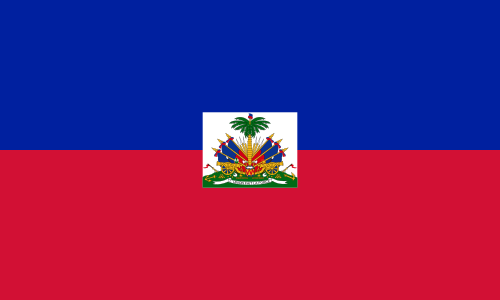
Haiti
AyitiAyiti
Tournament outlook
2026-05-27One famous afternoon — 52 years on from Manno Sanon
- ▸First World Cup since West Germany 1974 — 52 years
- ▸Coach Sébastien Migné has never been able to set foot in Haiti due to security situation
- ▸Wilson Isidor switched allegiance from France to Haiti in 2025 — six Premier League goals at Sunderland this season
- ▸Diaspora squad: only one player (Woodensky Pierre) plays in Haiti's domestic league
- ▸Duckens Nazon, all-time leading scorer, scored hat-trick to beat Costa Rica away in qualifying
Haiti’s presence in the United States this summer is one of the more unlikely sporting facts of 2026. The country has not been to a World Cup since West Germany 1974. Its domestic league is functioning under the most precarious conditions of any FIFA nation on the planet. Its national team plays its “home” qualifying fixtures in Curaçao and the Dominican Republic. Its head coach, the French manager Sébastien Migné, has never been able to set foot in Haiti due to the ongoing security situation in Port-au-Prince. The 26 players who will represent Les Grenadiers in Boston, Philadelphia, and Atlanta have, with one exception, been developed entirely in the diaspora — France, Belgium, England, Portugal, Hungary, the Netherlands, Slovakia, Iran, the United States, Canada, and Ecuador. The exception is Woodensky Pierre, a midfielder at Violette Athletic Club in Port-au-Prince. He is, on his own, the entire domestic footprint of this squad.
The qualification run that brought them here ran through Concacaf’s third round. Haiti, third-ranked in a group with Honduras and Costa Rica, beat Costa Rica away from home — Duckens Nazon, the team’s all-time leading scorer, registering a hat-trick — and then dispatched Nicaragua, ultimately winning the playoff route to claim a World Cup berth. Wilson Isidor, who switched allegiance from France to Haiti in March 2025 after coming off a strong Premier League season at Sunderland (six goals), is the squad’s most recent and most consequential addition. Jean-Ricner Bellegarde at Wolves brings Premier League midfield quality. Veteran captain and goalkeeper Johny Placide (Bastia) is the senior voice. The squad’s average age is just 24.
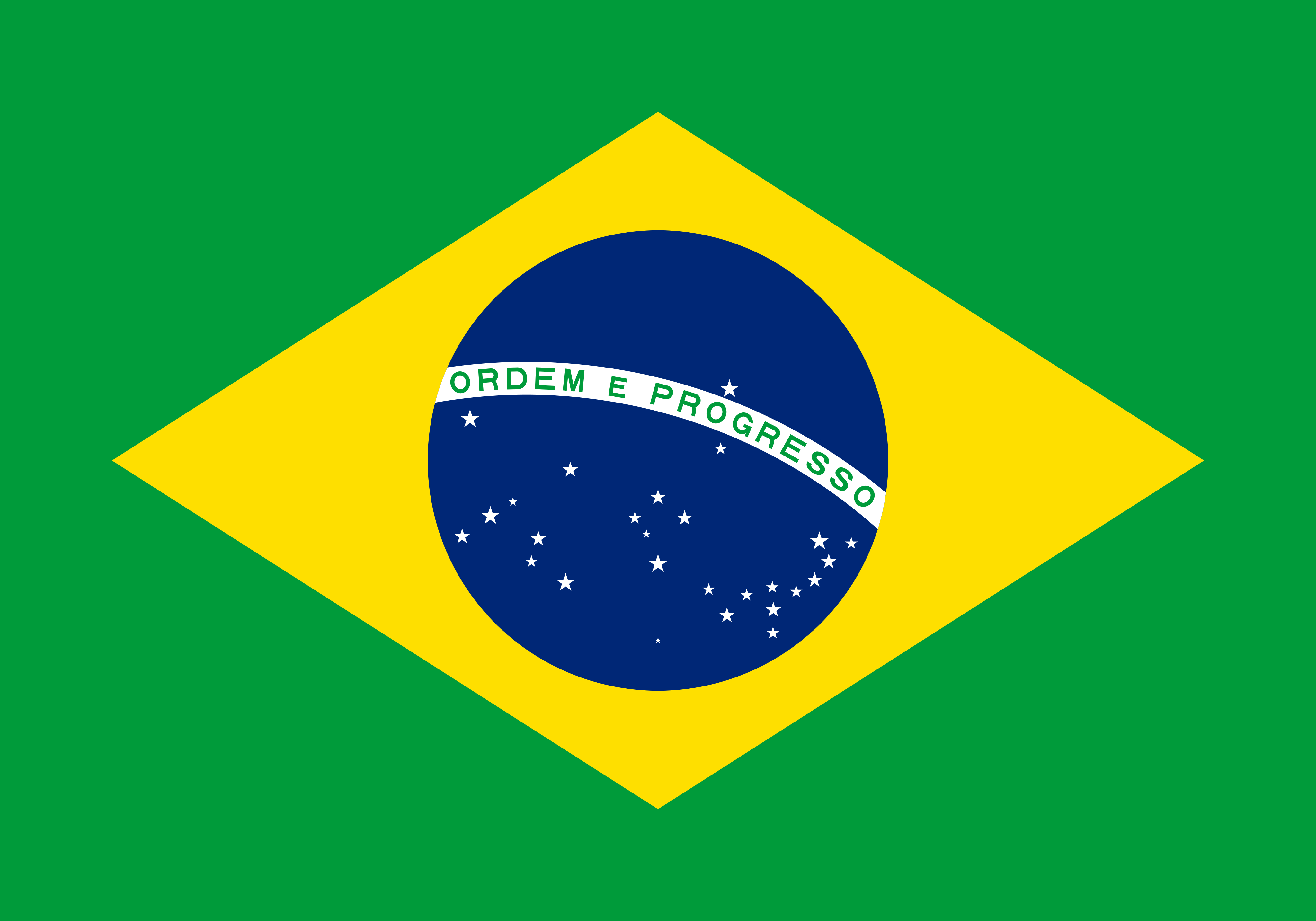
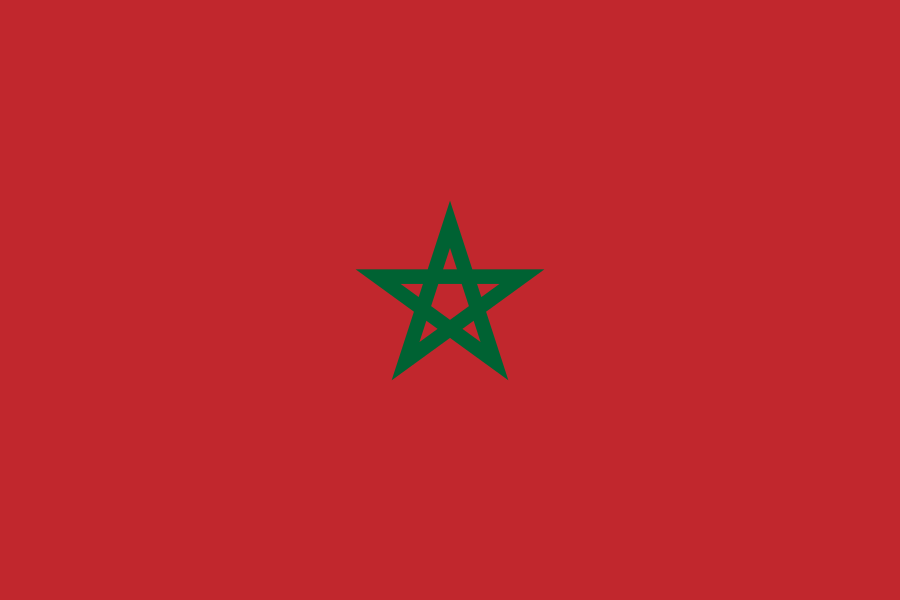
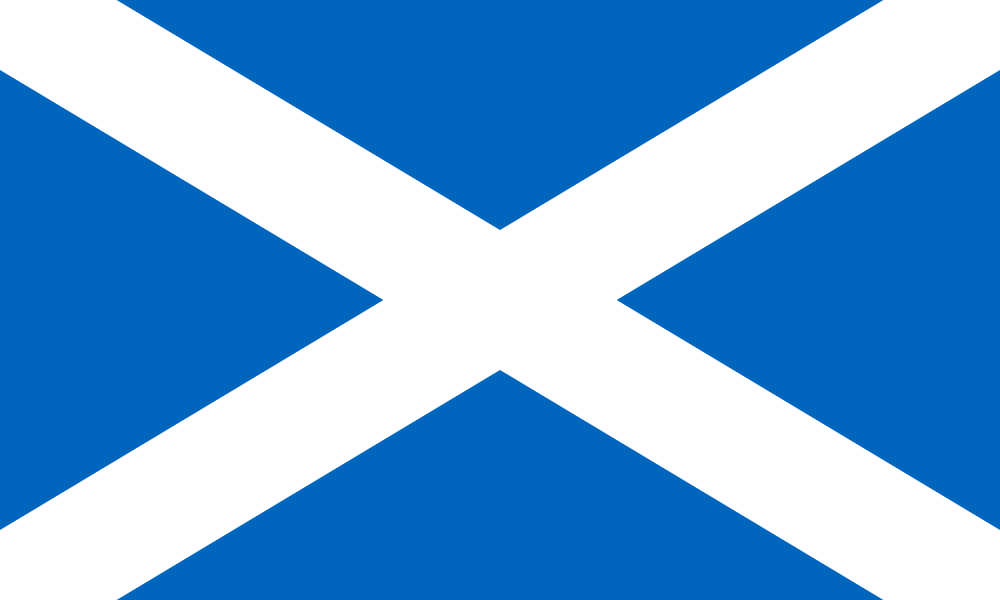
Group C is, for Haiti, a study in asymmetry. The realistic best-case scenario is one famous result — most plausibly the opener against Scotland on 13 June at Boston’s Gillette Stadium, where 60,000 will be split between large Haitian-American and Scottish diaspora communities. A draw there would be Haiti’s first World Cup point in 52 years; a win would be the country’s first World Cup victory ever. The worst-case scenario is three heavy losses, possibly conceding ten or more goals across matches against Scotland’s set-piece machine, Vinícius and Raphinha’s Brazil, and Hakimi and Mazraoui’s Morocco. Migné’s pragmatic 4-2-3-1, the loyalty he has shown to his core 22, and the energy of a squad with nothing to lose are the three assets he is bringing into a tournament where, on paper, none of his three opponents should lose to him.
About the team
depth: standardLes Grenadiers return after 52 years — a diaspora team chasing one famous afternoon
Low-to-mid block defending, fast vertical transitions through Bellegarde and Isidor, pragmatic and counter-attacking — built around continuity of the 22 players who carried qualifying · 4-2-3-1 / 4-3-3 (compact, transition-oriented)
Stunning Concacaf qualifying run — third in the final round, beat Costa Rica away, dispatched Nicaragua, finished above Honduras. First World Cup berth since 1974. Migné has stayed loyal to a 22-man core through qualifying.
- Premier League quality at both ends — Isidor (Sunderland) up top, Bellegarde (Wolves) in midfield
- Tactical chemistry from Migné's loyalty to a stable core
- Young squad — average age 24 — with energy to burn
- Nothing to lose; will play freely
- Massive talent gap vs. Brazil and Morocco
- Only one player based in Haiti's domestic league (Woodensky Pierre)
- Limited tournament-level experience — most of the squad has never played at this stage
- Defensive depth is thin against elite wide attackers
Haiti’s qualification story is one of the great underdog runs of the cycle. With most of the country’s football infrastructure displaced by the security crisis — the national team has played “home” games in Curaçao and the Dominican Republic for over two years, and head coach Sébastien Migné has notably never been able to set foot on Haitian soil — Les Grenadiers entered the third round of Concacaf qualifying as the third-ranked team in a group also containing Honduras and Costa Rica. They left it as group winners, beating Costa Rica away from home (Duckens Nazon hat-trick) and then dismissing Nicaragua. It is Haiti’s first World Cup appearance since West Germany 1974, where they famously led Italy through Manno Sanon’s goal in their opening match before eventually finishing bottom of their group.
Tactically, Migné — a 53-year-old Frenchman with previous spells coaching Congo, Kenya, and Equatorial Guinea, and a former assistant under Claude Le Roy and Jean-Pierre Papin — has settled on a compact 4-2-3-1/4-3-3 hybrid. The team defends in a mid-low block and breaks vertically through the right flank where Bellegarde, when he drifts inside, finds Wilson Isidor in the channel. Isidor’s switch of allegiance from France to Haiti in early 2025, after six Premier League goals at Sunderland, is the single biggest non-coaching change in this team’s profile.
The squad is a diaspora project: of the 26 players, exactly one — midfielder Woodensky Pierre of Violette Athletic Club — plays his club football in Haiti. The rest are scattered across Ligue 1 and Ligue 2, the Belgian Pro League, the Premier League, the Eredivisie, the Hungarian top flight, Ecuador’s LDU Quito, Esteghlal in Iran, and MLS sides Colorado Springs and Toronto. The average age is 24. Goalkeeper-captain Johny Placide of Bastia is the senior figure.
History notes: Haiti’s only previous World Cup was 1974 in West Germany. They lost all three matches (Italy 3-1, Poland 7-0, Argentina 4-1), but Sanon’s goal against Dino Zoff broke the legendary Italian goalkeeper’s 1,142-minute international clean sheet. That fact remains the most cited piece of Haitian football trivia anywhere on the planet, and forms the emotional template for what Migné’s group is being asked to produce in 2026.
Ceiling: a single famous win or draw — against Scotland in Boston on June 13, most plausibly — that resets the country’s sporting memory for a generation. Floor: three honourable defeats, which is what most observers expect. Most likely: a competitive opener against Scotland followed by heavy losses to Brazil and a still-finding-itself Morocco. Group-stage exit either way, but the asymmetry between cost and reward of a single result is enormous.
2026 kits
All 48 →Fan-drawn representations via Wikipedia's kit templates — not official renders.
The Manager
Full profile →Sébastien Migné
French · since 2024-06
"Continuity, defensive structure, loyalty to a core squad. Compact 4-2-3-1 / 4-3-3 mid-low block with vertical transitions. Migné prizes tactical chemistry over rotation — he kept 22 players together through almost all of qualifying."
Sébastien Bernard Henri Clément Migné — born 30 November 1972 in La Roche-sur-Yon, Vendée — is the architect of one of the unlikeliest World Cup qualification stories of the 2026 cycle. A French coach who has never set foot in Haiti, he was announced as head coach by the Haitian Football Federation on 8 March 2024 and took up the role formally in June 2024, with the country’s security situation having made on-site work impossible for years. The Haitian senior team plays its “home” fixtures in Curaçao and the Dominican Republic; training camps for the World Cup itself are running in Port St. Lucie, Florida.
Migné’s coaching career has been a steady accumulation of African national-team experience. Beginning in the youth pyramid at French clubs, he moved into a long apprenticeship as assistant to Claude Le Roy and Jean-Pierre Papin — a stretch that included the Persian Gulf Cup-winning Oman staff. He took the DR Congo U-20 job in 2014 and qualified the team for a continental championship for the first time. Senior national-team work followed: Congo (March 2017 to March 2018), Kenya (May 2018 to August 2019, with Kenya nominated for CAF Men’s National Team of the Year 2018 for the first time), Equatorial Guinea (from November 2019), and most recently as assistant with Cameroon under various staffs from 2022 to early 2024.
The Haiti appointment, made by the FHF on 8 March 2024, has produced the result the federation wanted. Migné inherited a squad with Premier League quality (Bellegarde at Wolves, later Isidor at Sunderland after his 2025 allegiance switch), a deep diaspora pool across European and American leagues, and a country desperate for a footballing moment. His first major decision was strategic: he committed to a core group of 22 players and kept rotating them through qualifying rather than experimenting. That continuity carried Haiti through the third round of Concacaf qualifying, where they beat Costa Rica away from home and dispatched Nicaragua to take a World Cup spot from a group also containing Honduras. Haiti finished third in the table but won the playoff route to qualify outright, securing only the country’s second World Cup appearance — 52 years after Manno Sanon’s goal against Italy in 1974.
His World Cup stake is more emotional than tactical. Migné has spoken publicly about wanting to visit Haiti once the security situation allows. For now, the relationship he has built with his squad — through camps in Florida, the Dominican Republic, and across Europe — is the relationship that has to hold for three group-stage matches against Scotland, Brazil, and Morocco. A point in any one of them would be one of the great achievements of his career and one of the great results in modern Haitian sporting history.
Squad
26 players · announced 2026-05-15The chip on each player is their WC26 rating, tinted by tier:
- 85+ elite
- 75–84 strong
- 65–74 solid
- <65 squad
Gold outline = projected starting XI (best XI by rating, club minutes, caps & FC26).
Goalkeepers
Defenders
- 72 Jean-Kevin Duverne FC26 KAA Gent (BEL1) 30c 1g
- 71 Carlens Arcus N/A Angers (FRA1) 38c 1g
- 62 Ricardo Adé N/A LDU Quito (ECU1) 35c 2g
- 49 Martin Expérience N/A Nancy (FRA3) 22c 0g
- 63 Hannes Delcroix FC26 Lugano (SUI1) 12c 0g
- 62 Wilguens Pauguain N/A Zulte Waregem (BEL1) 20c 0g
- 55 Keeto Thermoncy N/A Young Boys Berne (SUI1) 18c 0g
- 51 Duke Lacroix N/A Colorado Springs Switchbacks (USA2) 25c 1g
Midfielders
- 87 Jean-Ricner Bellegarde FC26 Wolverhampton Wanderers (ENG1) 18c 4g
- 58 Jean-Jacques Danley N/A Philadelphia Union (USA1) 15c 1g
- 48 Leverton Pierre N/A Vizela (POR2) 20c 1g
- 52 Dominique Simon N/A FC Tatran Prešov (SVK1) 16c 2g
- 49 Carl-Fred Sainthe N/A El Paso Locomotive (USA2) 25c 2g
- 49 Woodensky Pierre N/A Violette Athletic Club (HAI1) 12c 0g
Forwards
- 73 Duckens Nazon N/A Esteghlal (IRN1) 55c 30g
- 61 Frantzdy Pierrot N/A Çaykur Rizespor (TUR1) 30c 8g
- 56 Louicius Deedson N/A FC Dallas (USA1) 14c 3g
- 70 Wilson Isidor FC26 Sunderland (ENG1) 5c 2g
- 60 Derrick Etienne N/A Toronto FC (USA1) 35c 6g
- 59 Josué Casimir N/A Auxerre (FRA1) 9c 1g
- 48 Lenny Joseph N/A Ferencváros (HUN1) 11c 3g
- 45 Yassin Fortune N/A Vizela (POR2) 7c 1g
- 44 Ruben Providence N/A Almere City (NED1) 10c 2g