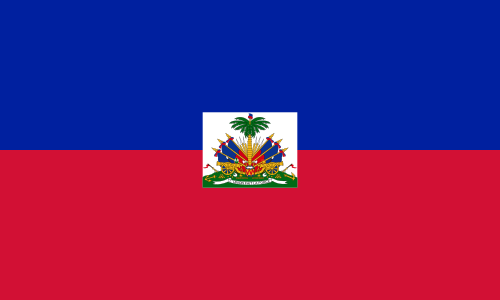
Sébastien Migné
French · age 53 · since 2024-06
"Continuity, defensive structure, loyalty to a core squad. Compact 4-2-3-1 / 4-3-3 mid-low block with vertical transitions. Migné prizes tactical chemistry over rotation — he kept 22 players together through almost all of qualifying."
Coaching journey
- Assistant head coach · Cameroon 2022-2024
- Head coach · Equatorial Guinea 2019-2021
- Head coach · Kenya 2018-2019
- Head coach · Congo 2017-2018
- Head coach · DR Congo U-20 2014-2016
- Assistant · Various (under Claude Le Roy and Jean-Pierre Papin — Oman senior team Persian Gulf Cup-winning staff among others) 2009-2017
Notable results
- ▸Qualified Haiti for 2026 World Cup — first appearance since 1974
- ▸Persian Gulf Cup winner with Oman (as assistant under Claude Le Roy)
- ▸Qualified DR Congo U-20 for continental championship for first time
- ▸Kenya nominated for CAF Men's National Team of the Year 2018 (first time in country's history)
Sébastien Bernard Henri Clément Migné — born 30 November 1972 in La Roche-sur-Yon, Vendée — is the architect of one of the unlikeliest World Cup qualification stories of the 2026 cycle. A French coach who has never set foot in Haiti, he was announced as head coach by the Haitian Football Federation on 8 March 2024 and took up the role formally in June 2024, with the country’s security situation having made on-site work impossible for years. The Haitian senior team plays its “home” fixtures in Curaçao and the Dominican Republic; training camps for the World Cup itself are running in Port St. Lucie, Florida.
Migné’s coaching career has been a steady accumulation of African national-team experience. Beginning in the youth pyramid at French clubs, he moved into a long apprenticeship as assistant to Claude Le Roy and Jean-Pierre Papin — a stretch that included the Persian Gulf Cup-winning Oman staff. He took the DR Congo U-20 job in 2014 and qualified the team for a continental championship for the first time. Senior national-team work followed: Congo (March 2017 to March 2018), Kenya (May 2018 to August 2019, with Kenya nominated for CAF Men’s National Team of the Year 2018 for the first time), Equatorial Guinea (from November 2019), and most recently as assistant with Cameroon under various staffs from 2022 to early 2024.
The Haiti appointment, made by the FHF on 8 March 2024, has produced the result the federation wanted. Migné inherited a squad with Premier League quality (Bellegarde at Wolves, later Isidor at Sunderland after his 2025 allegiance switch), a deep diaspora pool across European and American leagues, and a country desperate for a footballing moment. His first major decision was strategic: he committed to a core group of 22 players and kept rotating them through qualifying rather than experimenting. That continuity carried Haiti through the third round of Concacaf qualifying, where they beat Costa Rica away from home and dispatched Nicaragua to take a World Cup spot from a group also containing Honduras. Haiti finished third in the table but won the playoff route to qualify outright, securing only the country’s second World Cup appearance — 52 years after Manno Sanon’s goal against Italy in 1974.
His World Cup stake is more emotional than tactical. Migné has spoken publicly about wanting to visit Haiti once the security situation allows. For now, the relationship he has built with his squad — through camps in Florida, the Dominican Republic, and across Europe — is the relationship that has to hold for three group-stage matches against Scotland, Brazil, and Morocco. A point in any one of them would be one of the great achievements of his career and one of the great results in modern Haitian sporting history.