
Panama
PanamáPanamá
Tournament outlook
2026-05-27Second World Cup, smarter Panama — the Christiansen project meets the brackets
- ▸Panama's second-ever World Cup appearance after a brutal 2018 debut (0 points, -9 goal difference)
- ▸Adalberto 'Coco' Carrasquilla — the country's most accomplished midfielder since Felipe Baloy era
- ▸Thomas Christiansen entering his sixth year in charge — the longest current tenure in CONCACAF
- ▸Aníbal Godoy, 36, captaining at his second World Cup with 130+ caps
- ▸Rematch of the 2018 England 6-1 Panama hammering — eight years later, in New York/New Jersey
- ▸Norwich City defender José Córdoba emerging as Panama's first European-based starting centre-back
Panama return to the World Cup eight years older, much smarter and substantially better organised than the 2018 vintage. Thomas Christiansen, in his sixth year as head coach, has stitched together a project around defensive shape, set-piece preparation and one genuinely top-tier CONCACAF player: Adalberto “Coco” Carrasquilla, the Pumas UNAM midfielder whose dribbling, range of passing and free-kick delivery would make him a starter at most mid-table La Liga clubs. The 26-man squad announced on 26 May at the Panama Canal Administration Building leans on a tight, mostly Latin America-based player pool, with Amir Murillo (Beşiktaş), Orlando Mosquera (Al-Fayha) and José Córdoba (Norwich City) the rare exceptions playing in Europe or its periphery.
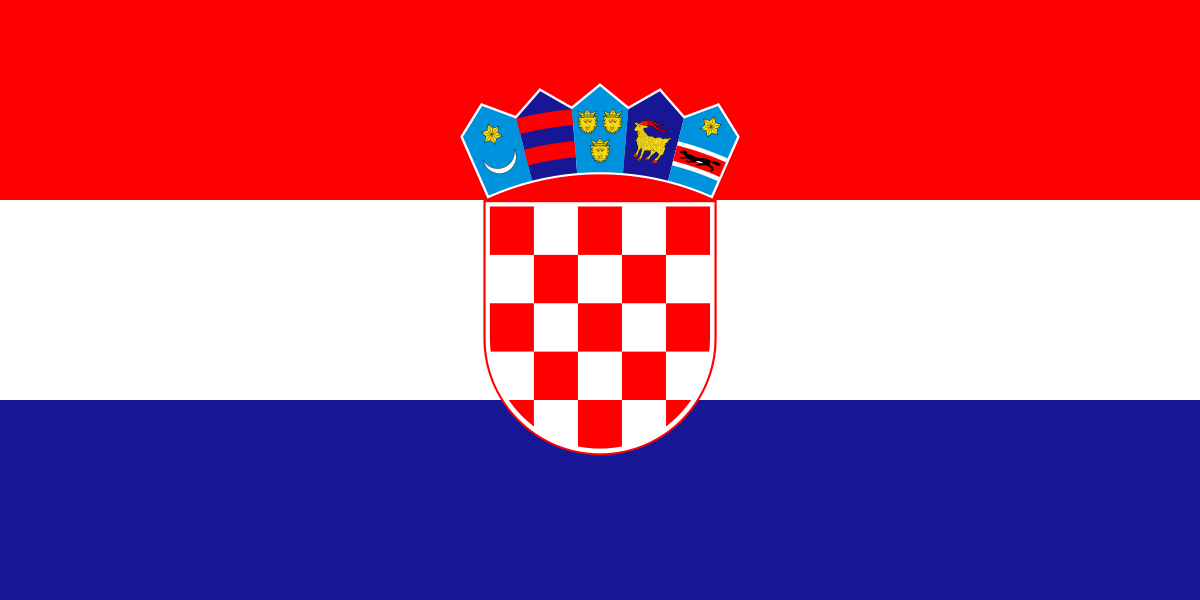
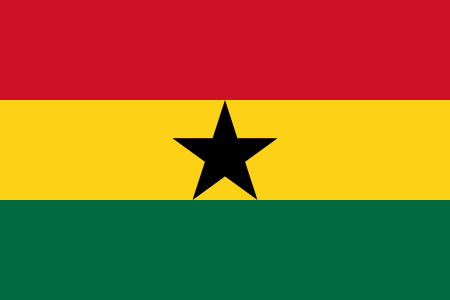
Group L is a difficult draw made more difficult by the bracket order. Ghana on 17 June at the Toronto Stadium is the must-win — both sides have similar talent levels, both are tactically rebuilding (Ghana more dramatically than Panama), and a loss in the opener effectively ends Panama’s tournament. Croatia on 23 June in Toronto is a first-ever meeting; Panama will sit deep, try to absorb Modrić’s tempo control, and hope a set piece falls their way. England on 27 June at New York/New Jersey Stadium is the highest-profile fixture in Panamanian football history — a rematch of the 6-1 hammering at the 2018 group stage in Volgograd, with Kane and Stones both back for England — and Panama will be a substantially more disciplined defensive side than the one Gareth Southgate’s team broke in half.
The ceiling is a round-of-16 appearance via best-third-place qualification, which would be a historic achievement and almost certainly the most important week in Panamanian football history. The floor is three group-stage defeats and an early flight home, which would still represent progress on 2018’s tournament debut given the more competitive matches Panama are likely to produce. The most likely scenario is one win (against Ghana), one narrow defeat (against Croatia), and a tournament-defining decision on the final matchday. Carrasquilla’s fitness — he suffered discomfort during the Liga MX final immediately before the squad announcement — is the single largest variable in the projection. With a healthy Carrasquilla, the ceiling is meaningfully higher. Without him, the floor becomes a real risk.
About the team
depth: standardChristiansen's second act — a smarter Panama returns with Coco Carrasquilla at the wheel
Low-block defensive shape, set-piece dependent, transition-led counterattacking — Panama under Christiansen are organised and physical rather than expressive. · 4-1-4-1 (deep block; transitions to 4-4-2 on counter)
Solid for tier 3. Came through the CONCACAF route with a competitive qualifying campaign, including a notable win over Costa Rica. Squad announced 26 May at the Panama Canal Administration Building.
- Adalberto Carrasquilla — genuine top-tier CONCACAF midfielder at Pumas UNAM
- Tournament-tested core: Aníbal Godoy (130 caps), Amir Murillo, Fidel Escobar, Yoel Bárcenas
- Set-piece organisation drilled across five years of Christiansen's tenure
- Goal threats spread across the line — Ismael Díaz, Cecilio Waterman and José Fajardo all proven at international level
- Carrasquilla's fitness concerns post-Liga MX final
- Goalkeeping depth — Mosquera is solid but the alternatives are inexperienced
- No European top-five-league regulars in the starting XI
- Set-piece dependency means low expected goals from open play against organised sides
Panama returns to the World Cup eight years older, smarter and substantially better organised than the 2018 vintage that finished its tournament debut bottom of Group G with a goal differential of minus 9. Thomas Christiansen, the Danish-Spanish former striker who took the national-team job in July 2020, has put in five-plus years of cumulative work — through the Concacaf Gold Cup, the Nations League, and the 2024 Copa América — turning Panama into a side that is hard to beat rather than a side that competes for entertainment value. The 26-man squad unveiled on 26 May at the Panama Canal Administration Building is a project, not a roll call. The average international experience is high; the average European top-five-league exposure is low; the average tactical discipline is, by Concacaf tier-three standards, very high.
The team is built around Adalberto “Coco” Carrasquilla — a Pumas UNAM midfielder who is, by some distance, Panama’s best player and one of the most complete midfielders in CONCACAF. Carrasquilla controls tempo, takes free kicks, breaks lines vertically and recovers possession high. His fitness has been the only meaningful talking point at the camp: he suffered discomfort in the Liga MX final shortly before the squad announcement and is being closely monitored. If he plays at 100%, Panama has a midfield axis around which the rest of the team can scaffold. If he doesn’t, the responsibility falls to 36-year-old captain Aníbal Godoy — long-serving, reliable, but a step slower than the player Carrasquilla replaced him beside.
Tactically, Christiansen has settled on a 4-1-4-1 that defends in a compact 4-4-1-1 block and counters through Ismael Díaz and Cecilio Waterman. The full-backs — Amir Murillo (Beşiktaş) on the right, César Blackman or Eric Davis on the left — do not bomb forward. The wide attackers (Bárcenas, José Luis Rodríguez, José Fajardo) work hard defensively and offer width in transition. Set pieces, drilled over years, are Panama’s most reliable goal source. The team is not designed to win possession battles; it is designed to make the game small, ugly and decided on margins.
The Group L draw has given Panama a winnable opener and two heavy underdog spots. Ghana on 17 June at the Toronto Stadium is effectively the must-win of the campaign — both sides have similar talent ceilings, both have new(ish) tactical structures, and the loser is realistically eliminated. Croatia on 23 June in Toronto is a first-ever meeting; Panama will sit deep, try to survive Modrić, and hope a set piece falls their way. England on 27 June at the New York/New Jersey Stadium is a rematch of the 2018 6-1 hammering — eight years on, with Christiansen rather than Hernán Darío Gómez in the dugout, Panama will be a far more defensively coherent side, but the talent gap remains daunting. The realistic ceiling is qualifying for the round of 16 as the best third-placed team; the floor is three group-stage defeats. The most likely outcome is a single win, a single defeat by a narrow margin, and a tournament-defining decision in the final group game.
2026 kits
All 48 →Fan-drawn representations via Wikipedia's kit templates — not official renders.
The Manager
Full profile →Thomas Christiansen
Danish-Spanish · since 2020-07-23
"Defensively compact 4-1-4-1, set-piece obsessed, transition-led attacking — the team is designed to make the game small and decided on margins. Christiansen invests heavily in physical conditioning, group cohesion, and dead-ball patterns, betting that organisational quality can close gaps in individual talent against bigger nations."
Thomas Christiansen is in his sixth year as Panama head coach, the longest current tenure at any CONCACAF national team, and arguably the most influential figure in modern Panamanian football. Born Thomas Christiansen Tarín on 11 March 1973 to a Danish father and Spanish mother, he played as a striker through the late 1990s and 2000s — at Barcelona B, Hannover 96, Bochum and most notably in La Liga at Compostela and Villarreal — before retiring in 2007. His coaching path was unhurried: youth roles at Barcelona, an FC Andorra spell, then his first senior break in May 2016 at APOEL Nicosia, where he won the Cypriot First Division title in his only full season, losing only two league games and posting 27 clean sheets — a defensive record that defined his style going forward.
The Leeds United adventure in 2017-18 was the brief, public stumble: appointed by Andrea Radrizzani to replace Garry Monk in June 2017, he was dismissed eight months later in February 2018 with the Championship side tenth in the table. The takeaway from England was that Christiansen’s defensive methodology travelled, but his ability to handle a chaotic ownership and a transient squad did not. He moved to AEK Larnaca for two years in Cyprus, then took the Panama national-team job on 23 July 2020 — replacing Américo Gallego in the middle of a federation restructure. Six years on, Panama have qualified for their second World Cup, reached a Concacaf Gold Cup final (2023, lost to Mexico), and competed credibly in the 2024 Copa América.
The tactical fingerprint at Panama is now thoroughly Christiansen’s: a 4-1-4-1 that defends in a compact 4-4-1-1 mid-block, transitions through Carrasquilla and Bárcenas, and finishes with Díaz or Waterman in space. The set-piece work is among the most polished at the tournament — Panama scored multiple goals from corners across the 2023 Gold Cup run and qualifying — and is the team’s most plausible source of goals against superior opposition. Christiansen has spoken in Spanish-language press conferences about wanting Panama to “compete with dignity rather than hope for accidents,” a line that captures the deliberate, anti-romantic tone of his project.
The 2026 World Cup is the highest stage Christiansen has ever managed on, and the most important week of his career sits in mid-to-late June. Group L gave him an opener (Ghana, 17 June at Toronto Stadium) that is winnable, then two heavy underdog tests against Croatia and England. The realistic expectation is a single win, a single narrow defeat and a tournament-defining finale. The bigger question for the Panamanian federation is what comes next: Christiansen has been linked with European clubs intermittently since the 2024 Copa América, and a credible World Cup performance — even one without a knockout-round appearance — would almost certainly trigger interest. For now, his focus is the most defensively organised version of Panama yet, built precisely for the brackets the draw delivered.

Squad
26 players · announced 2026-05-26The chip on each player is their WC26 rating, tinted by tier:
- 85+ elite
- 75–84 strong
- 65–74 solid
- <65 squad
Gold outline = projected starting XI (best XI by rating, club minutes, caps & FC26).
Goalkeepers
Defenders
- 92 Amir Murillo FC26 Beşiktaş (TUR1) 75c 3g
- 73 Andrés Andrade N/A LASK Linz (GER1) 22c 1g
- 61 Fidel Escobar N/A Saprissa (CRC1) 55c 2g
- 56 Jorge Gutiérrez N/A Deportivo La Guaira (VEN1) 38c 0g
- 76 Roderick Miller N/A Turan Tovuz (ENG1) 35c 1g
- 72 César Blackman N/A Slovan Bratislava (SVK1) 30c 1g
- 67 Eric Davis N/A CD Plaza Amador (ARG1) 95c 4g
- 62 José Córdoba N/A Norwich City (ENG2) 28c 0g
- 56 Edgardo Fariña N/A FC Pari Nizhny Novgorod (RUS1) 18c 0g
- 56 Jiovany Ramos N/A Academia Puerto Cabello (VEN1) 25c 0g
Midfielders
- 76 Cristian Martínez N/A Hapoel Ironi Kiryat Shmona (ENG1) 30c 4g
- 74 José Luis Rodríguez N/A Juárez FC (MEX1) 35c 5g
- 72 Aníbal Godoy (c) FC26 San Diego FC (USA1) 130c 5g
- 66 Azarías Londoño N/A Universidad Católica (ITA1) 18c 2g
- 64 Adalberto Carrasquilla (vc) N/A Pumas UNAM (MEX1) 50c 5g
- 61 Yoel Bárcenas N/A Mazatlán FC (MEX1) 60c 8g
- 60 Alberto Quintero N/A CD Plaza Amador (ARG1) 95c 9g
- 59 Carlos Harvey N/A Minnesota United (USA1) 22c 1g
- 54 César Yanis N/A Cobresal (CHI1) 25c 4g