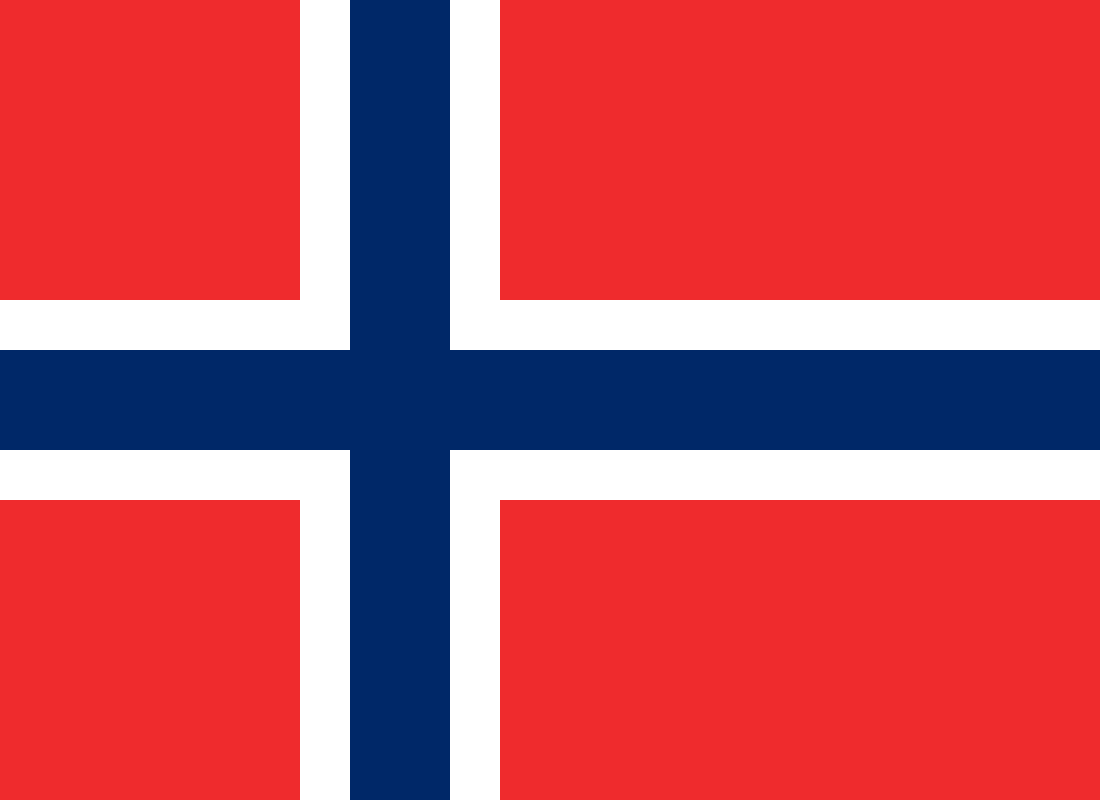
Norway
NorgeNorge
Tournament outlook
2026-05-27Norway return after 28 years with Haaland, Ødegaard, and the deepest squad in their history
- ▸First World Cup since France 1998 — 28 years of qualifying near-misses ended
- ▸Erling Haaland's World Cup debut — 16 goals in 8 qualifying matches; the highest pre-tournament expectation since Lionel Messi 2014
- ▸Martin Ødegaard's first major senior tournament; second time as Norway captain at a finals
- ▸Ståle Solbakken — first Norway manager to qualify since Egil Olsen in 1998
- ▸Norway's perfect qualifying — eight wins from eight, only Spain matched the 37 goals across UEFA
Norway have not been to a World Cup since France 1998. The country missed seven consecutive tournaments, suffered playoff heartbreak in 2022 against Serbia, and watched the football generation that included Haaland and Ødegaard get closer to peak with each missed cycle. The 2025-26 qualifying campaign ended the drought emphatically: eight wins from eight, 37 goals scored, four conceded, and a UEFA qualifying record that only Spain matched. The pre-tournament hype is fair. Norway are unmistakably the most dangerous unseeded team in the field.
The tactical model is unambiguous and not particularly subtle. Solbakken’s 4-3-3 fixes Haaland centrally as the penalty-area destination; Ødegaard operates from the left half-space; Antonio Nusa, Oscar Bobb, Strand Larsen or Sørloth provide the wide running and crossing. Sander Berge and Patrick Berg screen the midfield; Julian Ryerson is one of Europe’s most tactically intelligent right-backs. The defence is the area where Norway look unmistakably below the world-class level — Kristoffer Ajer, Leo Skiri Østigård, Torbjørn Heggem — but the structure Solbakken has installed is enough to limit the goals-against tally against most international opponents.
The schedule could not have been kinder: Iraq first (a clear three-point fixture), Senegal second (the swing match), France last in Boston (where Norway can either tie up the group or rest legs depending on the matchday-2 outcome). The realistic path is six points from Iraq and Senegal, qualification clinched, France treated as a free-look matchday 3 with rotation. The ceiling is genuinely the quarter-finals: with Haaland and Ødegaard at their best, Norway are not significantly weaker than England or Portugal, and the round-of-16 draw against a Group L or H third-placer favours them. The floor — Iraq win, Senegal loss, France defeat — is real but unlikely. Most likely outcome: through as runners-up, a winnable round of 16, and then the question of whether Haaland’s first knockout World Cup match becomes a coronation or a sobering education.
About the team
depth: deepNorway are back — 28 years on, with Haaland, Ødegaard, and unfinished business
Direct, vertical, devastating in transition. Haaland as the focal point, Ødegaard as the conductor, pace and crosses in wide channels · 4-3-3 (drops to 4-5-1 against elite midfields)
Excellent. Eight wins from eight in qualifying including a 3-0 in Oslo against Italy and a 4-1 vs Israel. Friendly form has been less ruthless (a 2-2 in March 2026 vs Switzerland) but the qualifying numbers are unprecedented — only Spain matched Norway's 37 goals across Europe.
- Erling Haaland — 16 goals in 8 qualifying matches; 55 international goals in 49 caps (all-time Norwegian leader)
- Martin Ødegaard — Arsenal captain, Norway captain, elite creator
- Strikes in depth: Alexander Sørloth (Atlético Madrid), Jørgen Strand Larsen (Wolves), Antonio Nusa (RB Leipzig)
- Perfect qualifying record — 8 wins from 8, 37 goals scored, only Spain matched the attacking output in Europe
- Tactical clarity under Ståle Solbakken — fifth full year in charge
- Defensive depth still League One-tier in places — Sondre Langås (Derby), Henrik Falchner (Viking)
- Goalkeeping uncertainty: Ørjan Nyland (Sevilla) is first choice but rarely tested at elite club level
- No prior World Cup experience for almost the entire squad — only manager Solbakken has been involved in a senior World Cup campaign
- Midfield drops off sharply after Ødegaard and Sander Berge
Norway’s last World Cup was in France in 1998, where they upset Brazil 2-1 in Marseille and reached the round of 16 before falling to Italy. Between then and now, Norway missed seven consecutive World Cups, four Euros (until 2024-25, also missed), and watched neighbours Denmark and Sweden lap them in tournament football. The drought ended in November 2025 in style: eight matches, eight wins, 37 goals scored, four conceded, top of UEFA qualifying Group I and into the World Cup with games to spare. They are, on the qualifying numbers alone, the best Norwegian football team ever assembled.
The reason is partly luck — having Erling Haaland and Martin Ødegaard in the same generation is unrepeatable — and partly the patient work of Ståle Solbakken, now in his fifth full year as national team manager. The framework is a 4-3-3 built around Haaland’s penalty-area dominance and Ødegaard’s left-half-space orchestration. Sander Berge (Fulham) anchors midfield; Antonio Nusa (Leipzig) and either Oscar Bobb (Manchester City) or Strand Larsen (Wolves) supply the wide running and crossing. The defensive numbers in qualifying (4 goals conceded in 8) flatter a back line that was not regularly tested by elite opposition — but Solbakken’s mid-block defending and Julian Ryerson’s tactical intelligence at right-back have given Norway competitive defensive structure for the first time in a decade.
The squad announcement on 21 May 2026 produced no genuine surprises. Three goalkeepers — Ørjan Nyland (Sevilla), Egil Selvik (Watford), Sander Tangvik (Hamburg) — none of whom regularly start in the Premier League/Bundesliga top flight. The defence leans on Kristoffer Ajer (Brentford), Leo Skiri Østigård (Genoa) and Torbjørn Heggem (Bologna). The forward line is the headline: Haaland and Sørloth as a double-pivot of devastating finishers, with Nusa, Bobb, Strand Larsen and Thelo Aasgaard (Rangers) providing rotation. No genuine experiment was made; this is the squad Solbakken trusted to qualify and the one he trusts to perform.
The group draw rewards Norway’s lack of tournament miles with a forgiving opener (Iraq), a swing fixture (Senegal), and a marquee finale against France in Boston that could decide group winner — or for Norway, simply confirm progression. The ceiling is genuinely the semi-finals: with Haaland and Ødegaard, an in-form Norway is not significantly weaker than England or Portugal, and the new 48-team format opens up softer round-of-16 matchups. The floor is a Sweden-2018-style group exit if the defence is exposed early. Most likely outcome: through as runners-up, into a top-half-of-the-bracket round-of-16 against a Group L or H team, and one knockout win away from matching the country’s 1998 best-ever finish. Either way, after 28 years away, Norway are no longer the World Cup’s most conspicuous absence. They might be its most dangerous returner.
2026 kits
All 48 →Fan-drawn representations via Wikipedia's kit templates — not official renders.
The Manager
Full profile →Ståle Solbakken
Norwegian · since 2020-12-04
"Vertical, structured football. A 4-3-3 with explicit roles: Haaland as a fixed central reference point, Ødegaard as the free creator from the left half-space, two pivots covering territory behind. Believes in clarity over complexity — every player knows their job before they leave the dressing room."
Ståle Solbakken has been the Norway head coach since 3 December 2020 — well over five years and 60+ matches — and is the first manager to take the country to a World Cup since Egil Olsen in 1998. The drought he ended was nearly three decades long. He did it by winning all eight of his qualifying matches, scoring 37 goals in the process. Only Spain matched that attacking output across European qualifying. It is the highest-quality work of his managerial career, and quite possibly the most efficient World Cup qualifying campaign any Norway team has ever produced.
His path to the national-team job was long and unmistakably his own. Born in Kongsvinger in 1968, Solbakken’s playing career was cut short in 2001 when he suffered cardiac arrest during training with Wimbledon FC, a medical emergency that effectively ended his career as a midfielder. He retired and turned to coaching at second-tier HamKam in 2002, won immediate promotion, took Norway’s Manager of the Year award in 2004, and from there moved to FC Copenhagen — the club that would define his career. Across two stints (2006-2011, 2013-2020) he won eight Danish Superliga titles, took Copenhagen to a Champions League round of 16 (a first for any Danish club), and built the largest body of trophy work by any Norwegian manager in modern history.
His non-Copenhagen ventures were the rougher chapters. A single season at 1. FC Köln in 2011-12 ended in relegation. A six-month stint at Wolverhampton Wanderers in 2012-13 ended in January after a 2-1 FA Cup defeat to non-league Luton Town. Both stints reinforced his subsequent commitment to environments he could control end-to-end — which is why his second Copenhagen tenure delivered the best work of his career and why his Norway job is recognisably built on Copenhagen principles: clear roles, vertical attacking patterns, structural defending in mid-blocks.
The 2026 World Cup is Solbakken’s first as a head coach. The squad he announced on 21 May confirmed continuity over experimentation — the qualifying spine in midfield and attack is intact, with only injuries and form determining the bench rotations. He has been explicit in press conferences that his single tactical brief is to get the best out of Haaland (the highest-ceiling striker in tournament football) and Ødegaard (an underrated playmaker who consistently outperforms his Norway numbers when surrounded by enough quality). A round-of-16 appearance would match Norway’s all-time best from 1998; a quarter-final would be the highest finish in Norwegian history. He turns 58 in February 2026 and has hinted privately that the 2028 Euros may be his stopping point. This is the campaign that will define everything he built.

Squad
26 players · announced 2026-05-21The chip on each player is their WC26 rating, tinted by tier:
- 85+ elite
- 75–84 strong
- 65–74 solid
- <65 squad
Gold outline = projected starting XI (best XI by rating, club minutes, caps & FC26).
Goalkeepers
Defenders
- 94 Julian Ryerson FC26 Borussia Dortmund (GER1) 38c 1g
- 92 Kristoffer Ajer FC26 Brentford (ENG1) 36c 1g
- 83 David Møller Wolfe FC26 Wolverhampton Wanderers (ENG1) 14c 0g
- 83 Leo Skiri Østigård FC26 Genoa (ITA1) 24c 1g
- 82 Fredrik Bjørkan FC26 Bodø/Glimt (NOR1) 18c 0g
- 75 Marcus Holmgren Pedersen FC26 Torino (ITA1) 22c 0g
- 68 Sondre Langås FC26 Derby County (ENG2) 6c 0g
- 60 Torbjørn Heggem FC26 Bologna (ITA1) 12c 0g
- 46 Henrik Falchner N/A Viking (NOR1) 3c 0g
Midfielders
- 96 Martin Ødegaard (c) FC26 Arsenal (ENG1) 64c 8g
- 88 Sander Berge FC26 Fulham (ENG1) 48c 4g
- 77 Morten Thorsby FC26 Cremonese (ITA1) 25c 2g
- 84 Fredrik Aursnes FC26 Benfica (POR1) 32c 3g
- 84 Kristian Thorstvedt FC26 Sassuolo (ITA1) 24c 4g
- 78 Patrick Berg FC26 Bodø/Glimt (NOR1) 28c 1g
- 59 Thelo Aasgaard FC26 Rangers (SCO1) 10c 2g
- 54 Jens Petter Hauge N/A Bodø/Glimt (NOR1) 15c 1g
Forwards
- 96 Erling Haaland (vc) FC26 Manchester City (ENG1) 49c 55g
- 95 Alexander Sørloth FC26 Atlético Madrid (ESP1) 52c 16g
- 71 Antonio Nusa FC26 RB Leipzig (GER1) 18c 5g
- 79 Jørgen Strand Larsen FC26 Crystal Palace (ENG1) 22c 6g
- 72 Andreas Schjelderup FC26 Benfica (POR1) 8c 1g
- 64 Oscar Bobb FC26 Manchester City (ENG1) 12c 2g