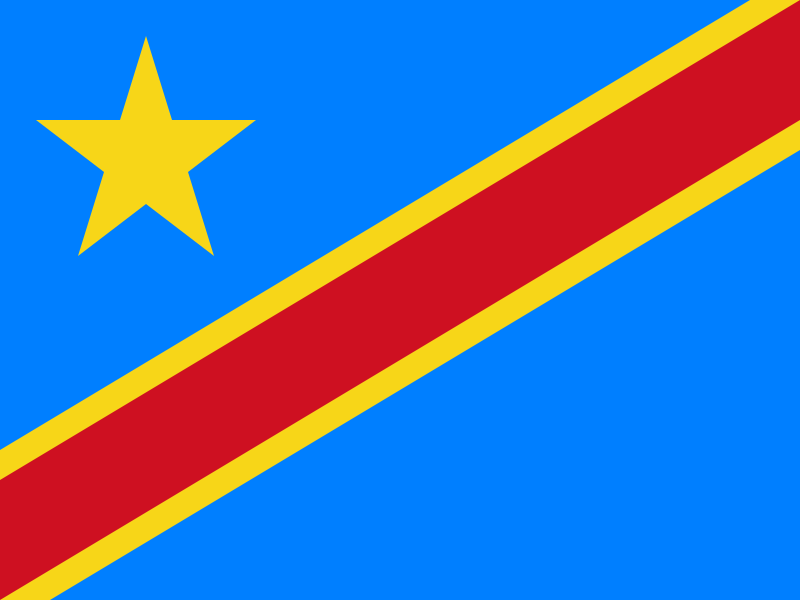
DR Congo
République démocratique du CongoRépublique démocratique du Congo
Tournament outlook
2026-05-27Group K's bold underdog — the Leopards return after 52 years targeting a knockout-round breakthrough
- ▸First DR Congo (then Zaire) World Cup appearance since 1974 — 52-year exile ends
- ▸Axel Tuanzebe's 100th-minute extra-time header beat Jamaica in the intercontinental playoff
- ▸Premier League contingent: Yoane Wissa (Newcastle), Aaron Wan-Bissaka (West Ham, switched from England in August 2025)
- ▸Chancel Mbemba captains the team at 31 with 107 caps — Leopards' all-time record
- ▸Desabre's stated public ambition: reach the round of 16 — the federation's first concrete tournament target in decades
- ▸Pre-tournament training relocated to Morocco due to Ebola precautions in Équateur province
- ▸Historic 1974 trauma — Zaire conceded 14 goals in three matches, scored zero — is the explicit baseline for redemption
DR Congo’s 2026 World Cup preview is, more than any other Group K team’s, a story of redemption rather than ambition. The Leopards last played at a World Cup in 1974, when they competed as Zaire under Mobutu Sese Seko, conceded 14 goals across three matches (including a 9-0 defeat by Yugoslavia), failed to score, and became a global punchline that has shadowed Congolese football ever since. Fifty-two years and a dozen failed qualifying cycles later, Sébastien Desabre has finally engineered the return — culminating in Axel Tuanzebe’s 100th-minute headed goal against Jamaica in the FIFA intercontinental playoff that decided the last automatic CAF berth.
Group difficulty is real but navigable. Portugal are clear favorites and will likely top the group; Colombia are heavy favorites for second. DR Congo’s most realistic three points come against Uzbekistan on 27 June in Atlanta — the final group match, and the only one in which the Leopards will not be outright underdogs. The standard scenario is a respectable defeat to Portugal in the opener (4-2-3-1 dropping to 5-3-2), a creditable performance against Colombia, and then a must-win against fellow first-time tournament participants Uzbekistan to chase a best-third-place berth into the round of 32. With the 48-team format and 24 automatic qualifiers from the groups, plus eight best-third-placed teams, the path to the knockout rounds is wider than ever — but DR Congo still needs at least three points to genuinely contend.
Desabre’s stated public ambition is the round of 16, an honest target that the squad has internalized. The Premier League contingent — Wissa, Wan-Bissaka, Tuanzebe — provides tournament temperament; the European depth (Mbemba, Bakambu, Banza, Kakuta, Sadiki) ensures every position has experienced cover. Two off-pitch concerns shape the preparation: the relocation of pre-tournament training to Morocco because of Ebola outbreaks in Équateur province, and the broader political symbolism of the Leopards’ campaign at a time of renewed conflict in eastern DRC. Ceiling: round of 16, becoming the first DR Congo / Zaire side to win a World Cup match. Floor: three group defeats, no points, an exit that nevertheless dignifies the 1974 baseline. Most likely: one win (vs Uzbekistan) and a draw, finishing third in the group and chasing a best-third tiebreaker into the round of 32.
About the team
depth: standardThe Leopards return after 52 years — Desabre's disciplined CAF dark horses
Deep defensive block, compact mid-block, explosive vertical transitions; physical intensity meets African flair · 4-2-3-1 (drops to 5-3-2 against elite opposition)
Excellent. Unbeaten in their CAF qualifying group, third-place finish at AFCON 2024 (Côte d'Ivoire), reached final of CAF playoffs, then beat Jamaica 1-0 in extra time in the FIFA intercontinental playoff via Axel Tuanzebe's 100th-minute header. Desabre has earned a lengthy contract extension.
- Premier League defensive pedigree — Wan-Bissaka (West Ham), Tuanzebe (Ipswich-era), Bushiri, Batubinsika
- Yoane Wissa: 19 Premier League goals for Newcastle in 2025-26, top-class pace and finishing
- Chancel Mbemba: 107-cap captain, vastly experienced after Porto, Marseille and Lille
- Tactical discipline — Desabre has not lost a competitive match since 2024
- Strikers with European pedigree: Bakambu, Banza, Mayele
- First World Cup tournament experience for all 26 players — no precedent for the moment
- Limited squad depth at goalkeeper outside of Mpasi
- Vulnerable to high-quality possession sides who can break the mid-block
- Centre-forward production has been streaky in qualifying
DR Congo’s return to the World Cup is the kind of redemption story FIFA’s expanded 48-team format was built to enable. The Leopards last appeared at a senior World Cup in 1974, playing as Zaire under Mobutu Sese Seko, and were so traumatized by a 9-0 defeat to Yugoslavia and 14 goals conceded across three matches that the team became a global punchline. Fifty-two years later — having weathered a civil war, repeated federation chaos, and a dozen coaching changes — Sébastien Desabre’s side has earned a return that no Congolese player has ever experienced. The qualifying journey culminated in a 100th-minute headed goal from Axel Tuanzebe against Jamaica, in the FIFA intercontinental playoff staged in Mexico, that sent the Leopards through with the last automatic CAF spot decided by a one-game shootout.
Desabre, a 49-year-old Frenchman who spent his early career working through Cannes and Asec Mimosas before guiding Uganda to the AFCON 2019 round of 16, has transformed DR Congo into one of the most tactically organized teams in Africa. His preferred 4-2-3-1 sits deeper than CAF tradition demands but explodes vertically in transition, attacking through Yoane Wissa’s pace and the late runs of Edo Kayembe and Noah Sadiki. Defensive shape is non-negotiable; the Leopards have not conceded more than one goal in any competitive match in nearly 18 months. Against elite possession sides, Desabre will compress into a 5-3-2 and dare opponents to break a low block organized by Mbemba, Bushiri and Aaron Wan-Bissaka, the West Ham defender who switched allegiance from England in August 2025 and has already become a fixture at right-back.
The squad reflects the African football diaspora at its most diverse. Of the 26 players named on 18 May, 19 ply their trade in Europe’s top five leagues, with a Premier League contingent (Wissa at Newcastle, Wan-Bissaka at West Ham, Tuanzebe) providing both quality and tournament temperament. Chancel Mbemba, 31, is the spiritual leader: 107 international caps make him the all-time record appearance holder for the Leopards, and his rehabilitation from Newcastle reserve to Marseille fixture to Lille starter mirrors the national team’s own climb. Veteran striker Cédric Bakambu, with more than 50 international goals, anchors a forward line completed by Simon Banza and the in-form Fiston Mayele. The squad’s average age (27.4) is younger than at AFCON 2024, where they finished third.
Two factors loom outside the football. FIFA and the Congolese federation have been in discussions through May 2026 about Ebola precautions for the squad, after outbreaks in Équateur province; the conversations have not affected the squad list but have shaped pre-tournament training, which is taking place in Morocco rather than at home. Politically, the team has become a unifying force at a time of renewed tension in the east of the country — a role the federation has leaned into with the public framing of “the Leopards return.”
Ceiling: round of 16, becoming the first DR Congo / Zaire side to win a World Cup match. Floor: three group-stage defeats and a respectful exit, though even this would be a more dignified showing than 1974. Most likely: a draw and a win — likely against Uzbekistan in the final group game — sneaking into the round of 32 (or 16, depending on tiebreaker) and validating the most successful CAF qualifying campaign in DR Congo’s history.
2026 kits
All 48 →Fan-drawn representations via Wikipedia's kit templates — not official renders.
The Manager
Full profile →Sébastien Desabre
French · since 2022-08-08
"Deep defensive organization with explosive vertical transitions. Compact 4-2-3-1 mid-block that drops to 5-3-2 against elite opposition. Pragmatic, physical, transition-focused. Prioritizes set-piece coaching and defensive shape over possession. Believes African flair must be married to European tactical discipline."
Sébastien Desabre is the kind of coach the African continent has built quietly over two decades — a journeyman Frenchman who has clocked more time in CAF dugouts than most of his peers have spent watching CAF football. Born in Cannes in 1976, he began his managerial career in 2006 with French fifth-tier side ES Cannet Rocheville before, in 2010, taking the leap that would define his life: a job with Asec Mimosas in Côte d’Ivoire. From there came stops at Coton Sport (Cameroon), Étoile du Sahel (Tunisia), USM Alger (Algeria), Ismaily (Egypt) and finally the Uganda national team in late 2017, where he led the Cranes to the AFCON 2019 round of 16 — Uganda’s first knockout-round appearance since 1978.
The DR Congo job came in August 2022, after Argentine Héctor Cúper’s tenure ended in qualifying failure. Desabre inherited a squad rich in raw material — Mbemba, Wissa, Bakambu, Kakuta, Masuaku — but undisciplined and tactically inconsistent. His first major test, the 2023 AFCON staged in Côte d’Ivoire, ended in a semifinal exit and a third-place finish that exceeded all pre-tournament expectations. The Leopards went unbeaten through 90 minutes of normal time across the entire tournament, beating Egypt in the round of 16 and falling only to hosts Côte d’Ivoire in the last four. Desabre’s reputation across Africa was sealed; the federation rewarded him with a long-term extension.
Tactically, Desabre is the antithesis of the romantic notion of African football. His DR Congo plays a compact 4-2-3-1 with two genuine holding midfielders (typically Noah Sadiki and Edo Kayembe), a low defensive line, and explosive verticality in transition through Yoane Wissa. Against elite opposition he drops the back four into a back five and dares opponents to break a low block organized by Chancel Mbemba. The qualifying campaign for 2026 saw DR Congo concede just six goals in eight matches; the intercontinental playoff win over Jamaica was a textbook Desabre performance — disciplined, physical, decided by a set piece (Axel Tuanzebe’s 100th-minute header from a corner).
Heading into 2026, Desabre is in many ways the most experienced African-football coach in Group K. His decisions on pre-tournament training (relocated to Morocco due to Ebola concerns in DRC’s Équateur province), squad selection (sticking with the qualifying spine rather than chasing diaspora additions), and tactical setup (probable 5-3-2 against Portugal, 4-2-3-1 against Uzbekistan) will shape whether the Leopards end their 52-year exile with a memorable return or another reminder of how brutal the World Cup is to first-timers. The federation has already extended his contract; the players openly credit him with restoring DRC football’s dignity. The remaining variable is the tournament itself.
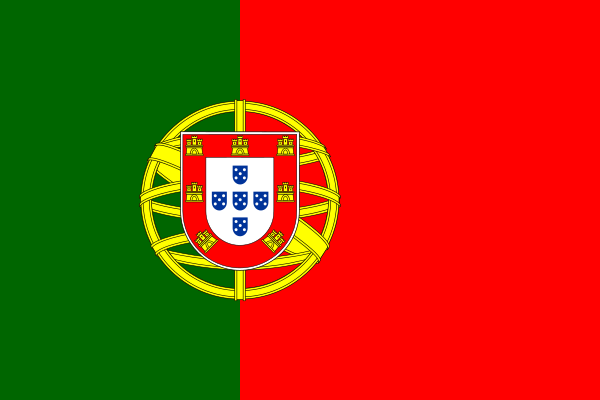
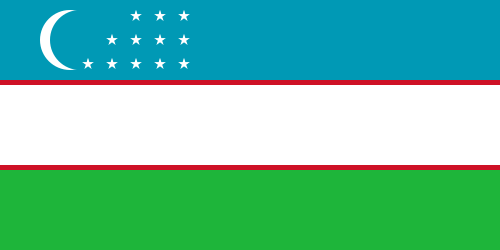

Squad
26 players · announced 2026-05-18The chip on each player is their WC26 rating, tinted by tier:
- 85+ elite
- 75–84 strong
- 65–74 solid
- <65 squad
Gold outline = projected starting XI (best XI by rating, club minutes, caps & FC26).
Goalkeepers
Defenders
- 94 Chancel Mbemba (c) FC26 Lille (FRA1) 107c 5g
- 87 Arthur Masuaku FC26 Lens (FRA1) 32c 1g
- 75 Joris Kayembe FC26 Racing Genk (BEL1) 14c 0g
- 68 Dylan Batubinsika FC26 AEL Larisa (GRE1) 16c 0g
- 91 Aaron Wan-Bissaka N/A West Ham United (ENG1) 9c 0g
- 77 Axel Tuanzebe FC26 Burnley (ENG1) 12c 2g
- 59 Gédéon Kalulu N/A Aris Limassol (CYP) 8c 0g
- 45 Steve Kapuadi N/A Widzew Łódź (POL1) 2c 0g
Midfielders
- 91 Théo Bongonda N/A Spartak Moscow (ENG1) 28c 4g
- 68 Edo Kayembe FC26 Watford (ENG2) 22c 1g
- 67 Samuel Moutoussamy N/A Atromitos (GRE1) 18c 1g
- 77 Meschack Elia FC26 Alanyaspor (TUR1) 26c 6g
- 74 Ngal'ayel Mukau FC26 Lille (FRA1) 6c 0g
- 70 Noah Sadiki FC26 Sunderland (ENG1) 12c 0g
- 67 Gaël Kakuta N/A AEL Larisa (GRE1) 32c 4g
- 57 Charles Pickel FC26 Espanyol (ESP1) 10c 0g
- 57 Brian Cipenga FC26 CD Castellón (ESP2) 5c 0g
- 51 Aaron Tshibola N/A Kilmarnock (SCO1) 16c 1g
- 46 Nathanaël Mbuku FC26 Montpellier (FRA2) 8c 1g