Gustavo Alfaro
Argentina · age 63 · since 2024-05-22
"Pragmatic defensive organisation — low-to-mid block, 4-4-2 or 4-2-3-1, narrow midfield, direct counter-attacks. 'Defensive organisation first, attacking intelligence second, individual brilliance as a bonus.' Heavy emphasis on set-piece routines and disciplined off-ball shape."
Coaching journey
- Manager · Costa Rica 2023-2024
- Manager · Ecuador 2020-2022
- Manager · Boca Juniors 2019
- Manager · Huracán 2017-2018
- Manager · Arsenal de Sarandí 2006-2013 (multiple spells), 2017
Notable results
- ▸2007 Copa Sudamericana title with Arsenal de Sarandí
- ▸Argentine Primera División title with Arsenal de Sarandí (2012 Clausura)
- ▸2012-13 Copa Argentina and Supercopa Argentina
- ▸Guided Ecuador to the 2022 FIFA World Cup (group stage exit)
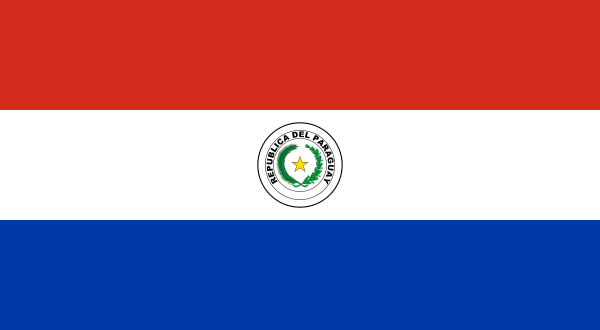
- ▸Qualified Paraguay for 2026 World Cup — first since 2010
- ▸Notable qualifying wins over Brazil and Argentina
Gustavo Julio Alfaro was born on 14 August 1962 in Rafaela, the small Argentine city in Santa Fe province that has, improbably, given South American football a disproportionate share of its managers. He never made it as a top-level player — a short career as a centre-back, captaining Atlético de Rafaela’s promotion to the Primera División in 1989 — and retired to coach at 30. That early start matters. Alfaro is one of the longest-tenured managers in South American football, with more than three decades of pragmatic, defensively-organised work across Argentine clubs, Ecuador’s national team, a brief stop at Costa Rica, and now Paraguay.
His breakthrough came at Arsenal de Sarandí. Taking over a club with almost no resources in 2006, he turned them into a continental winner — the 2007 Copa Sudamericana, beating Mexico’s América over two legs — and eventually a domestic league champion in the 2012 Clausura. The Arsenal years established what would become the Alfaro template: tight defensive shape, organised pressing triggers, set-piece preparation, and an absolute refusal to be intimidated by larger clubs. He repeated the trick at Huracán, then was given the Boca Juniors job in 2019 — a single, turbulent season that ended with a domestic title chase and a Copa Libertadores semi-final exit.
The international career started in 2020 when Ecuador, with the federation in financial chaos, hired him on a relatively modest deal. He delivered. Ecuador qualified for the 2022 World Cup in fourth place from CONMEBOL, beat Qatar in the opening match, drew the Netherlands, and were eliminated on goal difference after a 2-1 loss to Senegal. The contract did not survive the post-tournament dispute over salary arrears. A brief Costa Rica stint followed before Paraguay — sitting last in CONMEBOL qualifying after Daniel Garnero’s exit — appointed him in May 2024.
The Paraguay rescue has been the cleanest job of his career. Five points from eighteen when he arrived, Paraguay finished sixth in CONMEBOL with direct qualification, beat Brazil and Argentina along the way, and conceded the fewest goals of any team in the bottom half of the table. Alfaro himself has described the bond with Paraguay as “intense”; his public messaging — disciplined, humble, focused on collective effort — has connected with a country that had spent sixteen years watching three World Cups go by. He arrives in June with the tactical reputation as a defensive specialist who rarely loses the game his team is supposed to draw. The question is whether that template, against the USA’s pressing and Türkiye’s technical front four, can produce more than just survival.