Carlos Queiroz
Portuguese · age 73 · since 2026-04-14
"Defensively organised low-block football, transition-heavy attack, obsessive set-piece preparation. Pragmatic over expressive — Queiroz teams are designed to be hard to beat and decisive on the few clear chances they generate. Known for meticulous fitness and tactical-pattern drills, hostile relationship with journalists, and a willingness to take on rebuilding jobs at federations in disarray."
Coaching journey
- Head Coach · Oman 2025-2026
- Head Coach · Qatar 2023
- Head Coach · Iran 2022 (return for World Cup)
- Head Coach · Egypt 2021-2022
- Head Coach · Colombia 2019-2020
- Head Coach · Iran 2011-2019
- Head Coach · Portugal 2008-2010
- Assistant manager · Manchester United 2002-2003, 2004-2008
- Head Coach · Real Madrid 2003-2004
Notable results
- ▸FIFA World Cup squads (Iran) — 2014, 2018, 2022 (only manager to lead Iran at three WCs)
- ▸Portugal — knockout stage at 2010 FIFA World Cup
- ▸South Africa — qualified for 2002 FIFA World Cup
- ▸UEFA Champions League — assistant manager, Manchester United (2008 winners)
- ▸FIFA U-20 World Cup wins — Portugal (1989, 1991)
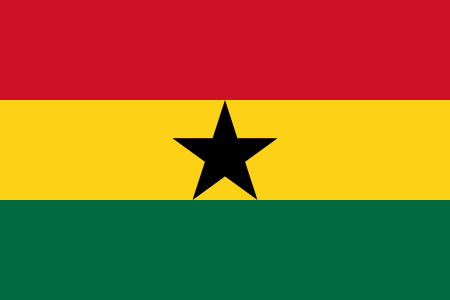
Carlos Queiroz took the Ghana job on 14 April 2026 in the most chaotic circumstances imaginable: eight weeks before the World Cup, after Otto Addo’s mid-March 2026 sacking, with a 28-player preparation squad still to be named and a tactical identity still to be built. The Portuguese is 73 years old, the oldest head coach at the tournament, and arrives with the resume of a working football lifer rather than a marquee strategist. Born in 1953 in Angoche, Mozambique (then Portuguese territory), Queiroz built his early reputation by winning the FIFA U-20 World Cup with Portugal in 1989 and 1991, then spent the next three decades as one of international football’s most peripatetic head coaches: South Africa, the UAE, Manchester United (as assistant to Sir Alex Ferguson, including the 2008 Champions League win), Real Madrid for a fraught single season, Portugal, Iran for almost eight years across two stints, Colombia, Egypt, Qatar, Oman, and now Ghana. He is the only manager in history to lead Iran at three World Cups (2014, 2018, 2022).
The Queiroz identity is well-established and largely independent of opposition: a defensively organised 4-2-3-1 that prioritises shape, transition pace and set-piece preparation over possession football. His Iran teams across three World Cups conceded fewer than one goal per game; his Portugal team reached the round of 16 in 2010 without conceding more than once. The trade-off is that Queiroz sides do not generate many goals — Iran scored a total of seven across their three Queiroz-led World Cup campaigns — and rely heavily on individual moments and dead-ball situations. The fit with Ghana’s player profile (pace, athleticism, a genuine European-level No. 10 in Mohammed Kudus, a striker-by-committee attack) is, on paper, better than it was for the Asian sides he previously coached.
The challenge is time. Queiroz had two friendlies in late May 2026 (against Austria and Germany, called by Addo’s caretaker successor) plus a Wales send-off match before the World Cup opener against Panama on 17 June. That is fewer than 90 days of work, and the tactical patterns he is trying to install — particularly the synchronised mid-block pressing trigger and the set-piece rotations — typically take a full international calendar to embed. Senior leaders Thomas Partey and Jordan Ayew have spoken publicly about the squad’s willingness to buy in, but the practical question is whether the Black Stars can hold their defensive shape against England’s structured build-up or Croatia’s midfield dominance with only weeks of pattern-recognition work behind them.
Queiroz’s career arc suggests he is being hired to do exactly the kind of job that defines his late-career identity: take a federation in disarray, install discipline quickly, and squeeze a credible tournament out of a talented but mismanaged squad. He has done it before — Iran in 2014, Iran in 2018, Egypt in 2022 (qualified for the AFCON final), Colombia in 2019 (Copa América quarter-final). The realistic ceiling for Ghana in 2026 is a round-of-16 appearance, repeating 2010. The realistic floor is a winless group stage that ends Queiroz’s tenure within months of it beginning. Neither outcome would be a surprise; both are firmly within his historical range.